Amy Sherald
Amy Sherald Is Painting America Into Being
Artist Spotlight · The Collection Editorial
“I want people to see themselves and to know that their existence matters, that they are worthy of being seen.”
Amy Sherald, The New Yorker, 2018
In the fall of 2023, Amy Sherald's sweeping retrospective opened at the San Francisco Museum of Modern Art before traveling to the Whitney Museum of American Art in New York, marking one of the most celebrated survey exhibitions of any living American painter in recent memory. The show brought together decades of work and introduced Sherald's singular vision to a generation of visitors who experienced her paintings not as documents of identity politics but as something far more intimate and immediate: portraits of people fully, luminously alive. The cultural conversation surrounding the retrospective confirmed what collectors and curators had long understood. Sherald is not simply one of the most important painters working today.
Amy Sherald
Handsome
She is one of the most important painters America has produced in a generation. Born in Columbus, Georgia in 1973, Amy Sherald grew up in a household that valued ambition and creativity, though her path to painting was neither straight nor simple. She earned her undergraduate degree from Clark Atlanta University before completing her Master of Fine Arts at the Maryland Institute College of Art in Baltimore, a city that would become central to her life and her imagination. Baltimore shaped her understanding of American class, race, and community, and its presence haunts her canvases in the most generous and attentive way.
Her formation was also marked by serious adversity. In 2004 she received a heart transplant, an experience that deepened her commitment to painting as a practice of witness and gratitude, a way of insisting on the value of every individual life placed before her. The years following her surgery became a period of remarkable artistic clarification. Sherald refined the technique that would become her unmistakable signature: rendering the skin tones of her African American subjects in grisaille, a spectrum of warm and cool grays, while surrounding them with floods of saturated, almost hallucinatory color.
Amy Sherald
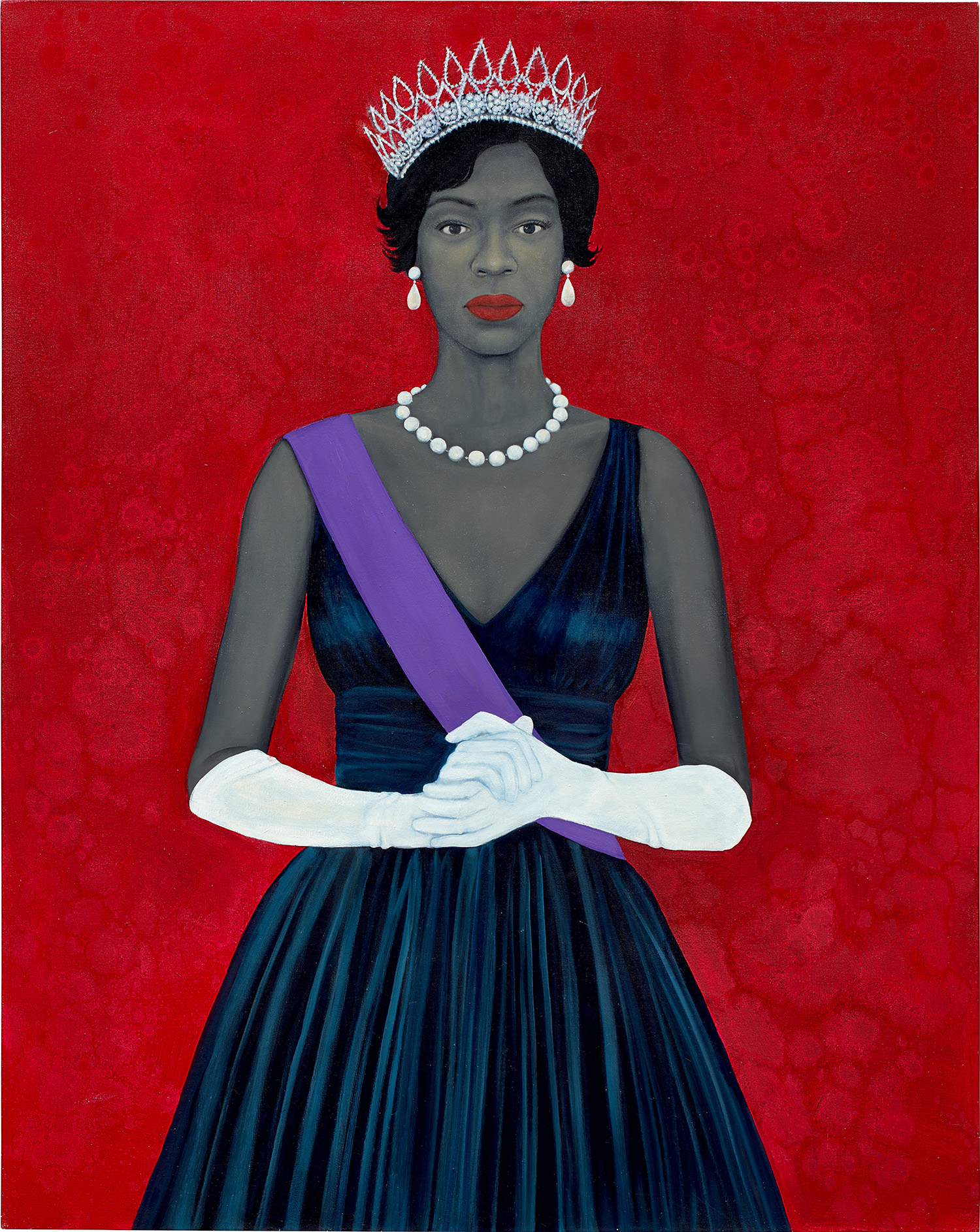
Welfare Queen, 2012
The choice is at once formal and philosophical. By removing the literal color of Black skin, she sidesteps the long and troubled history of racial typology in Western portraiture and forces the viewer to meet each subject as an individual first. The backgrounds and clothing, painted in candy pinks, electric blues, and sunlit yellows, carry the full emotional weight of personality and aspiration. It is a system of representation that feels genuinely new, arrived at through years of looking hard at everything from American realism and the Dutch Golden Age to the cool detachment of Alex Katz and the declarative energy of Barksy Gorky.
“My paintings are about being American. My figures just happen to be Black.”
Amy Sherald, Interview Magazine, 2018
The breakthrough came in a way that few artists ever experience. In 2016, Sherald won the Outwin Boochever Portrait Competition at the National Portrait Gallery in Washington, a prize that led directly to the commission that would change her life and reshape public conversation about American portraiture. Her 2018 portrait of Michelle Obama, unveiled at the National Portrait Gallery to extraordinary fanfare, presented the former First Lady in a voluminous gray gown against a pale blue ground, her gaze direct and entirely unintimidated. The painting was an event in the fullest sense, reproduced across every platform and discussed in every medium, and it introduced millions of people to an artist whose earlier work richly deserved that audience.
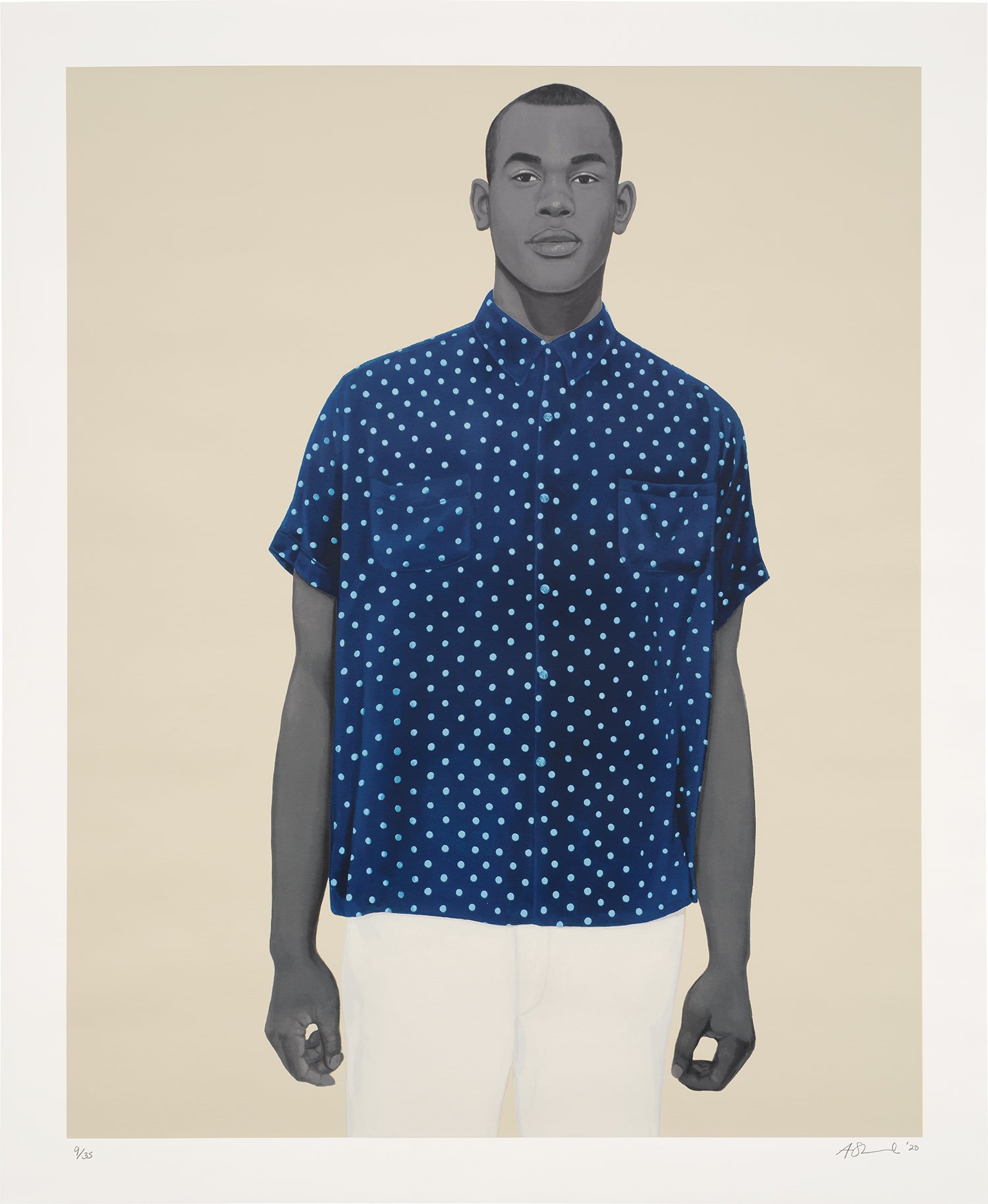
Amy Sherald
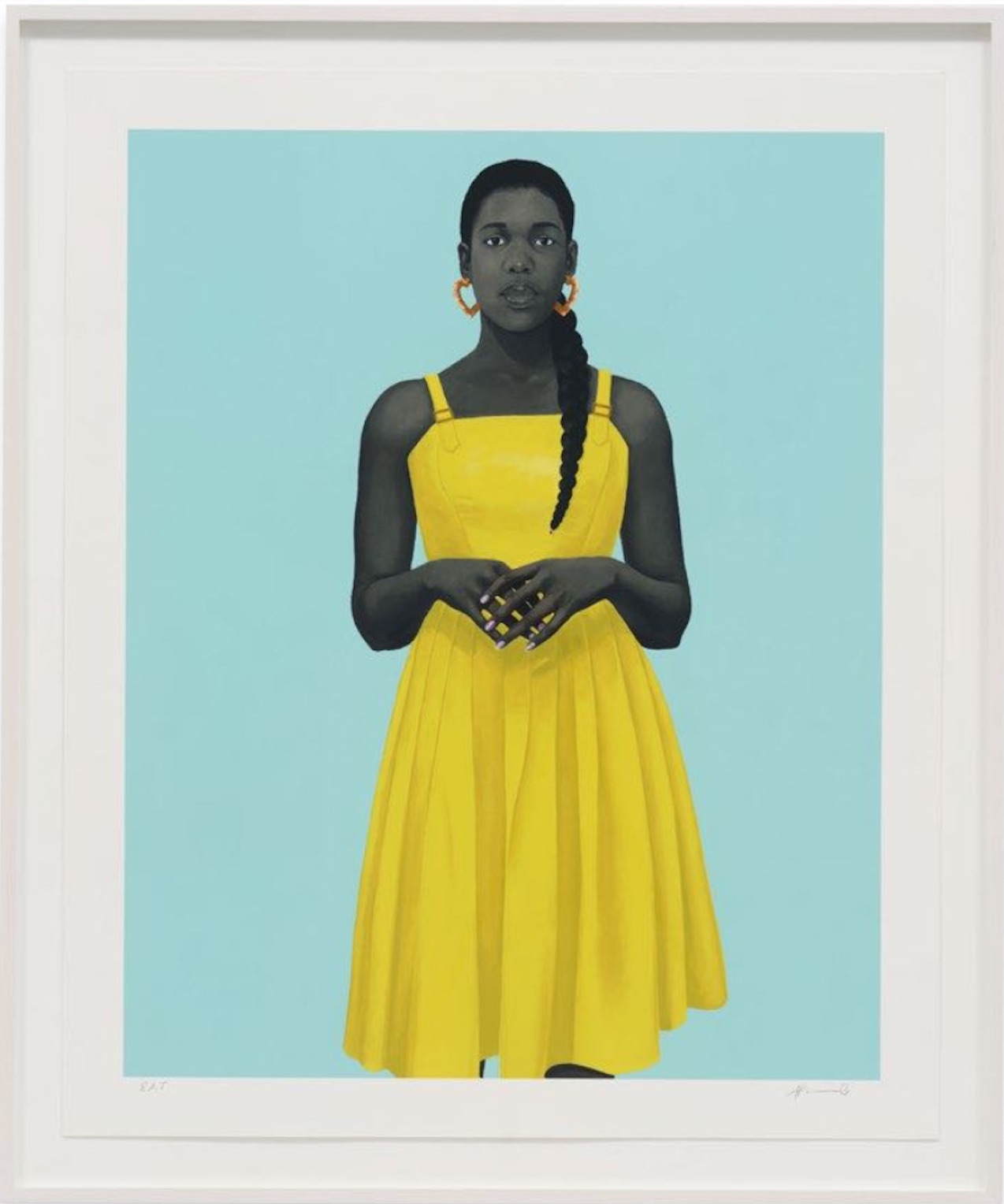
Untitled (Opal), 2021
It also made clear that Sherald's ambitions extended well beyond a single commission. The portrait succeeded because it was already consistent with everything she had been building toward for years. Looking across Sherald's body of work, several paintings stand as essential touchstones for any serious collector. Welfare Queen from 2012 remains one of her most arresting early canvases, presenting a subject of regal bearing against a flat field of color, its title reclaiming a phrase long weaponized as a political insult and redirecting it as an act of dignity.
The Bathers from 2015 nods to a grand tradition of leisure painting while insisting that Black Americans belong in that tradition and always have. Pilgrimage of the Chameleon from 2016 and She was learning to love moments, to love moments for themselves from 2017 show Sherald deepening her compositional confidence, placing figures in psychological spaces that feel both specific and archetypal. Her print editions, including the luminous Untitled (Opal) from 2021, a seventy color silkscreen on Lana Aquarelle paper, and her screenprints on Coventry Rag paper, offer collectors a way to engage with her palette and her figures at a range of price points without sacrificing any of the formal intelligence that defines her oils. From a collecting perspective, Sherald occupies a position that is genuinely unusual in the current market.
Amy Sherald
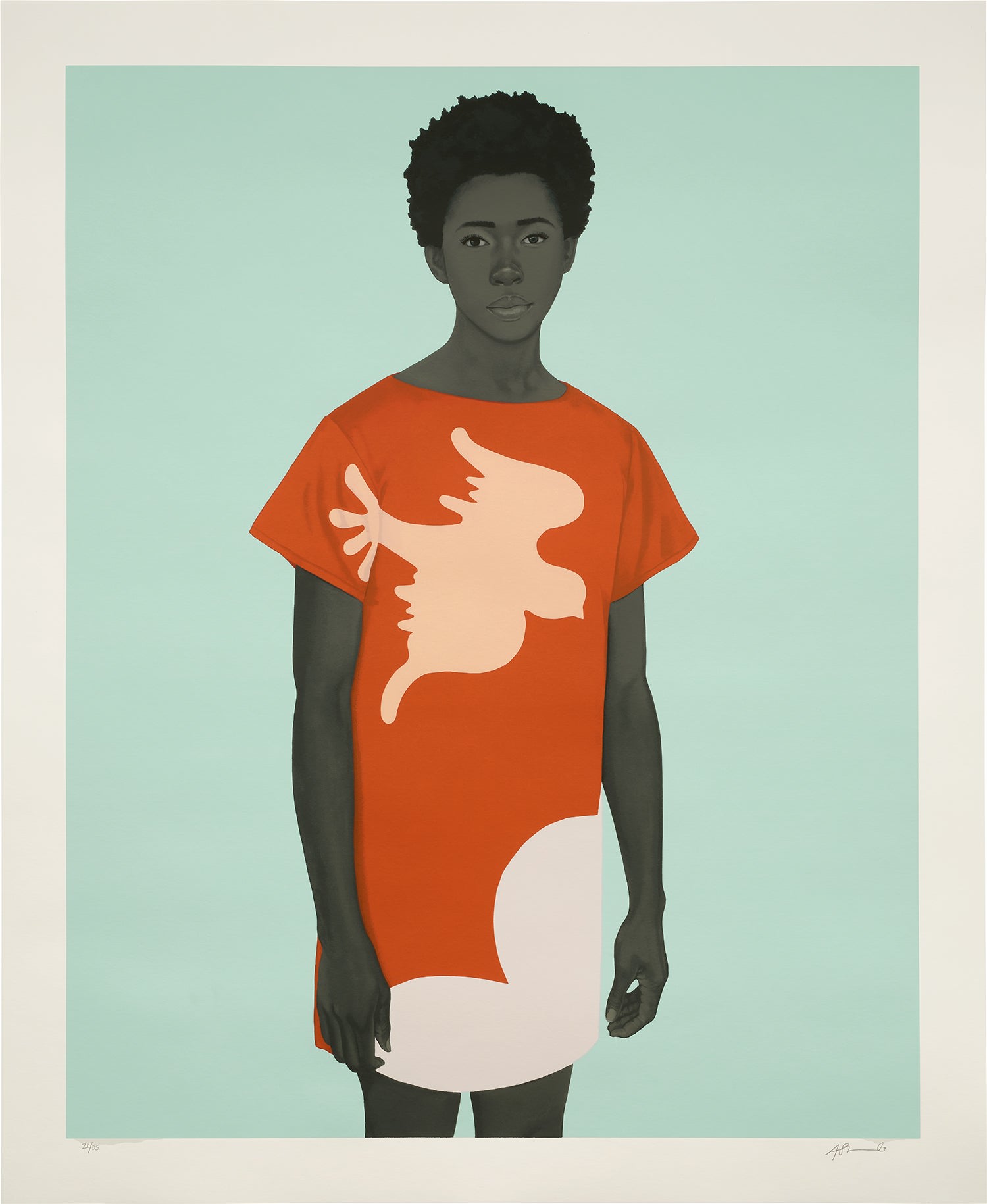
Hope is the thing with feathers (The little bird)
She is a living artist whose work has entered the permanent collections of institutions including the Smithsonian American Art Museum and the Baltimore Museum of Art, a level of institutional validation that typically takes decades to accumulate. Her auction profile has grown steadily, with secondary market results confirming sustained demand from both established institutions and newer private collectors who are building collections around questions of identity, visibility, and American experience. Works on paper and print editions from Sherald represent a particularly intelligent point of entry, offering works made with the same care and intentionality as her major canvases. Collectors drawn to Kerry James Marshall, Jordan Casteel, Titus Kaphar, and Lynette Yiadom Boakye will find in Sherald a natural conversation partner: painters who share a commitment to radical attention and to the proposition that figurative painting can still say something urgent and true.
What makes Sherald matter beyond the market and beyond the biographical facts is something harder to quantify. Her paintings insist on leisure, on dignity, on the right to exist in the full complexity of one's own interiority. The subjects she paints are not posed to explain themselves or to perform suffering. They simply are, occupying their space in the canvas with the same unquestioned authority that generations of European portrait subjects have always occupied theirs.
In a culture still working through deep questions about whose lives are rendered worthy of commemoration, Sherald's answer is clear and consistent and painted in the most beautiful colors imaginable. That answer is what collectors are responding to, and it is what will ensure her work endures long after the cultural moment that brought it to prominence has passed.
Explore books about Amy Sherald