Alma Singer
Alma Singer Finds Beauty in the Everyday
Artist Spotlight · The Collection Editorial
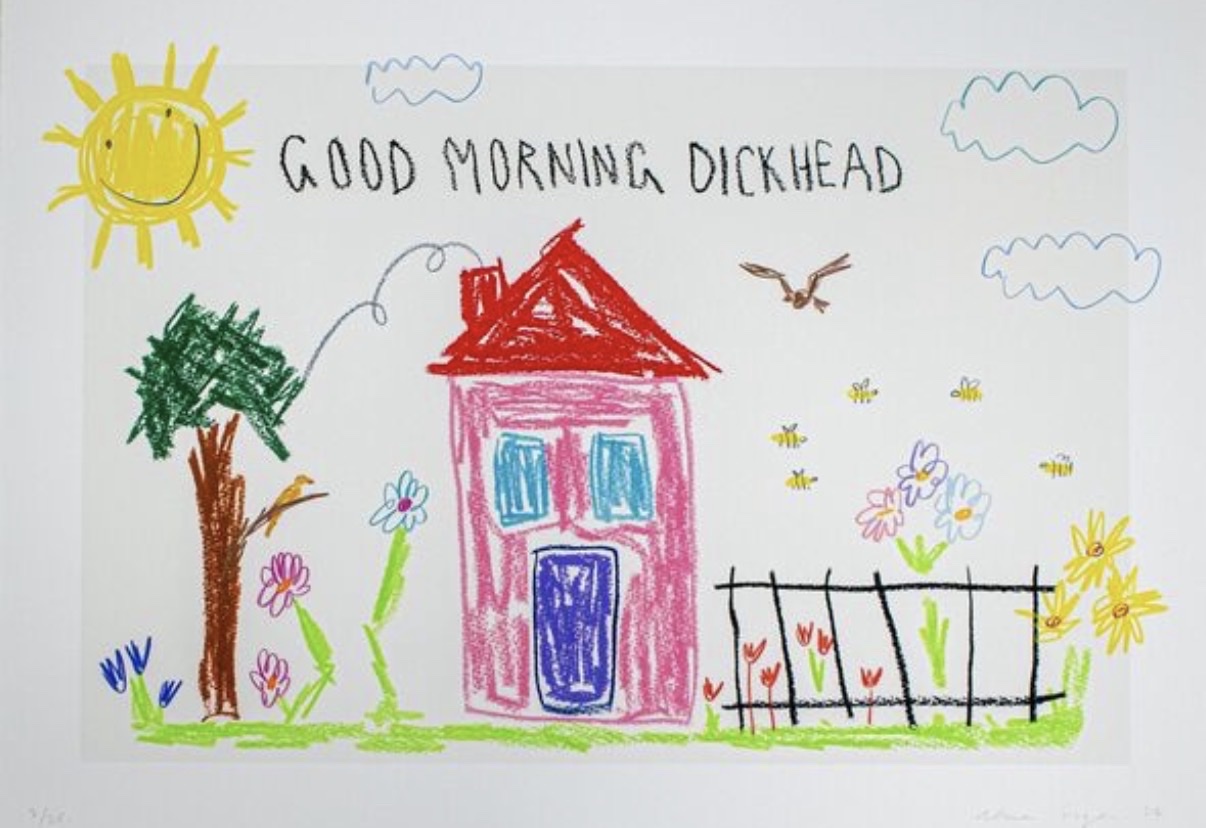
Something quietly urgent is happening in Alma Singer's studio. In 2024, she released one of her most talked about works to date, a piece whose title alone stopped viewers mid scroll and mid step in gallery spaces alike. "Good Morning Dickhead," an archival inkjet print hand finished with wax crayon on Somerset Enhanced Infinity 330gsm paper, announced itself with the blunt, affectionate irreverence of a morning text between old friends. It was a signal, to those paying attention, that Singer had arrived at a place of real confidence in her voice: tender and sharp at once, domestic and disarming, deeply personal yet immediately legible to anyone who has ever woken up next to another human being and felt the full comedy and warmth of that strange arrangement.
Alma Singer
Good Morning Dickhead, 2024
Singer is an American contemporary artist whose practice moves fluidly between painting and works on paper, and whose sensibility has been shaped by an abiding fascination with the interior life, both the physical interiors of rooms and the psychological interiors of the people who inhabit them. She draws upon memory, domesticity, and what might be called the emotional grammar of ordinary objects: a table set for two, the quality of afternoon light through a known window, the specific weight of a familiar silence. These are not small subjects. In Singer's hands they become the architecture of an entire emotional world.
The formation of an artist like Singer tends to happen in accumulation rather than in a single dramatic rupture. Her American roots ground her work in a tradition of close looking at the fabric of daily life, one that runs from the quieter corners of American realism through to the intimate figurative painters who emerged in the latter decades of the twentieth century. Artists such as Lois Dodd, Louisa Matthiasdóttir, and Nell Blaine, women who insisted on the radical sufficiency of the near at hand, feel like spiritual relatives. So too does the lineage of works on paper that has always run alongside and beneath the more celebrated canon of oil on canvas, a lineage in which the sketch, the notation, and the hand finished surface carry as much meaning as any finished monument.
Alma Singer
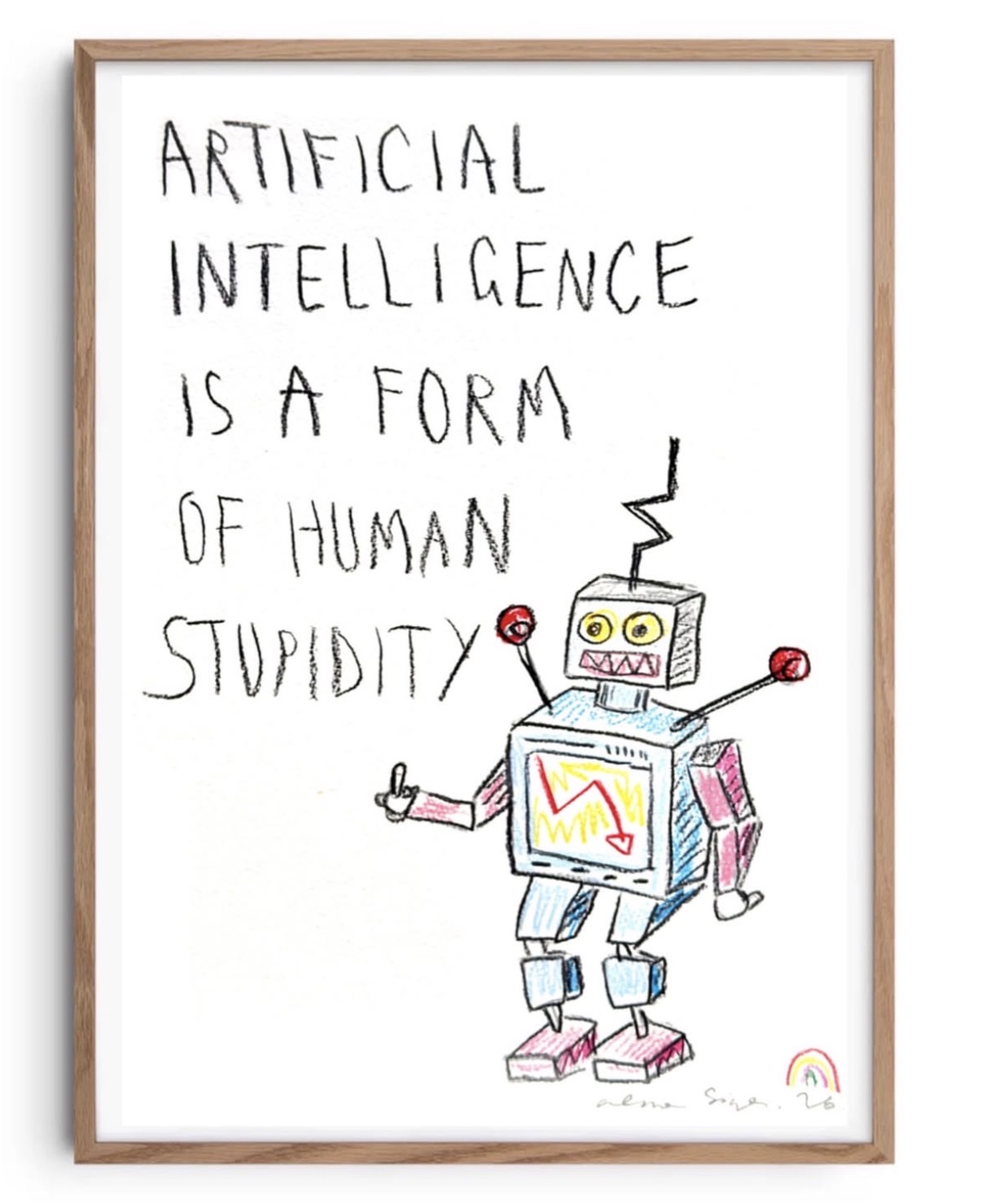
Artificial Intelligence Is a Form of Human Stupidity, 2026
Singer's artistic development reflects a practice built on layering, both literally and conceptually. Her choice of materials is never arbitrary. The use of archival inkjet as a base for "Good Morning Dickhead," subsequently worked over with wax crayon, speaks to an interest in the conversation between the mechanical and the handmade, between the fixed image and the living mark. Wax crayon, a medium with its own complex history in contemporary art from Cy Twombly's charged scrawls to Jean Michel Basquiat's insistent notations, carries in Singer's hands a sense of immediacy and vulnerability.
It is a medium that does not permit pretension. It arrives honest. Her 2026 work "Artificial Intelligence Is a Form of Human Stupidity," rendered in crayon and ink on paper, demonstrates the full range of what her titles can do. Where "Good Morning Dickhead" operates through intimacy, this newer piece operates through provocation and, beneath the provocation, genuine philosophical seriousness.
Singer is not making a throwaway joke. She is staking a position, insisting on the primacy of human mess, human error, human feeling, in a cultural moment that has become genuinely anxious about what machines can and cannot replace. That she makes this argument using crayon and ink, two of the most elementally human mark making tools imaginable, is not incidental. It is the argument.
For collectors, Singer's work presents an opportunity that comes along with real frequency but is recognized only in retrospect: the chance to acquire works from an artist whose singular voice is already audible and whose trajectory points clearly upward. Works on paper by artists of this quality, particularly when hand finished and materially considered as Singer's are, tend to appreciate both in market terms and in cultural significance as the artist's profile grows. The intimacy of the format is part of the appeal. These are works that live well in a home, that reward daily looking, that open differently depending on the mood you bring to them.
A Singer on the wall is a Singer in conversation with you, and that conversation shifts. In situating Singer within a broader art historical and critical context, it is useful to think not only about her American predecessors but about the generation of artists currently working in similar territory across both sides of the Atlantic. The renewed critical and market interest in figuration, particularly figuration that takes the domestic and the personal as its primary subject, has created a receptive environment for work like Singer's. Painters such as Cecily Brown, whose early career demonstrated that raw psychological energy and formal sophistication could coexist, or Lucy Dodd, whose works on paper collapse the boundary between the intuitive and the considered, offer useful coordinates.
Singer occupies her own position within this constellation, one defined by a distinctive tonal warmth and a commitment to wit as a form of emotional honesty. What Singer ultimately offers, and what makes her matter in this particular cultural moment, is a reminder that the small scale and the personal register are not retreats from significance. They are paths toward it. At a time when the art world can feel dominated by spectacle, by scale, by the algorithmic amplification of whatever is loudest, there is something genuinely countercultural about an artist who insists that a morning greeting, rendered in crayon and wax and honest feeling, is worth your full attention.
Singer's work asks you to slow down, to look closely, to find the drama hiding in the unheroic. And when you do, you find it everywhere.