Alfred Jensen
Alfred Jensen: The Universe Painted in Numbers
Artist Spotlight · The Collection Editorial
“I paint in numbers, and numbers paint a world that reason alone cannot reach.”
Alfred Jensen
There is a particular kind of genius that resists the moment it belongs to, and Alfred Jensen was precisely that kind of genius. In recent years, a quiet but steady reassessment has taken hold in museum circles and among serious private collectors, with institutions returning again and again to Jensen's extraordinary painted systems as precursors to so much of what contemporary art has come to value: the grid, the diagram, the marriage of scientific thought and spiritual seeking, the insistence that painting can carry the weight of an entire cosmology. His canvases, dense with impasto color and numerical logic, feel not like relics of postwar American painting but like urgent transmissions that have only recently found their proper audience. Jensen was born in 1903 in Guatemala City, to a Danish father and a German mother, and this transatlantic, cross cultural origin shaped everything that followed.
Alfred Jensen
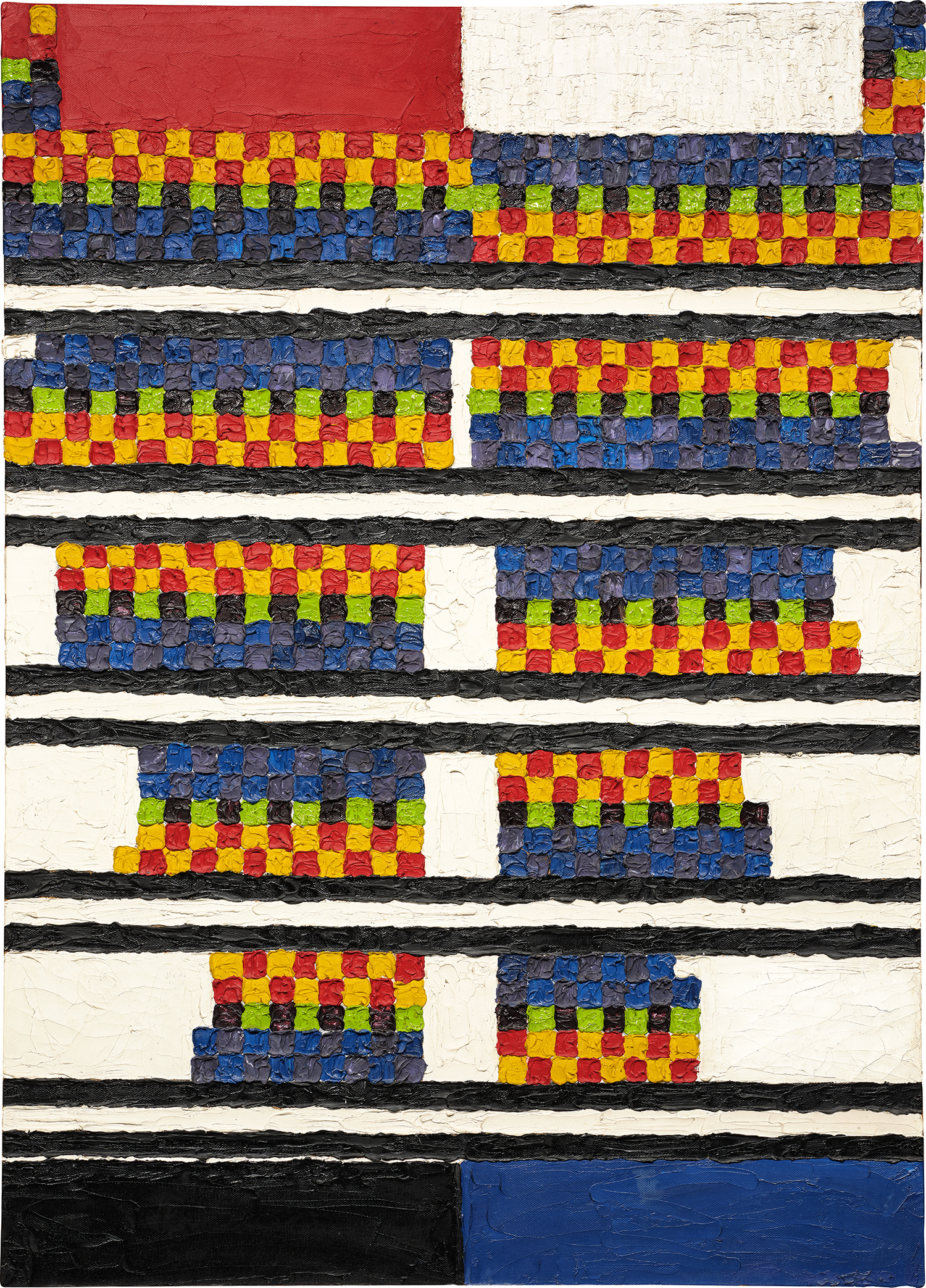
Interval in Six Scales. Per, VI (From a Mural in Five Panels), 1963
He spent his early years moving between continents, studying in Copenhagen and Munich before eventually making his way to Paris in the 1920s, where he encountered the full force of European modernism. He studied under Hans Hofmann, whose teachings about color relationships and pictorial tension left a deep and lasting mark. Paris also brought Jensen into contact with the collector Saidie May, who became both his patron and a formative influence, funding years of travel and study that took him across Europe and beyond. These were the years in which Jensen absorbed everything: Old Master technique, Goethe's color theory, ancient calendrical systems, and the mathematics underlying natural forms.
Jensen did not arrive at his mature style quickly or easily. He spent decades gathering the intellectual materials he would need, working through various idioms before committing to the singular visual language that would define his legacy. By the time he settled in New York in the 1950s and began exhibiting seriously, he had developed a practice unlike anything around him. Where Abstract Expressionism celebrated the gestural, the spontaneous, and the emotionally raw, Jensen was building structures.
Alfred Jensen
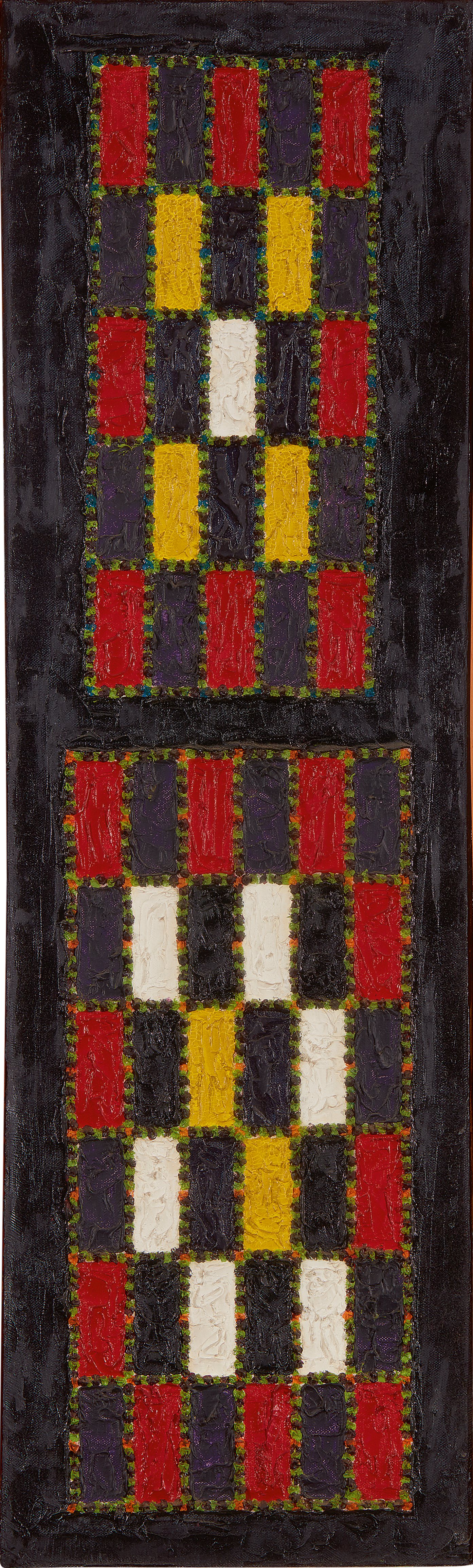
Even + Odd, 1968
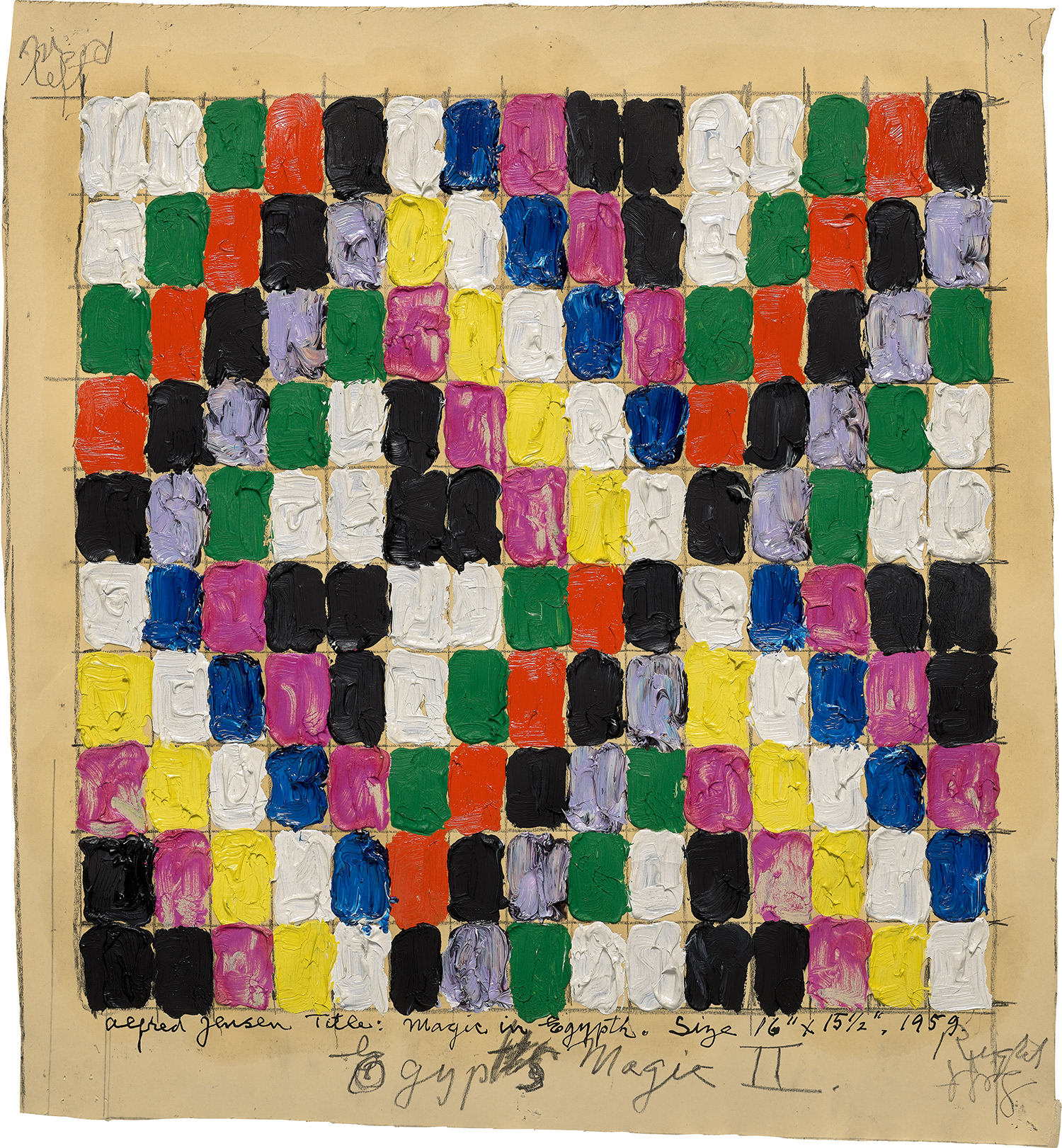
His paintings were planned with the rigor of a mathematician and executed with the physical intensity of a painter who believed that each mark carried meaning beyond the purely aesthetic. He aligned himself with no movement and no school, and this independence, while it sometimes made institutional recognition slower to come, ultimately became one of the most compelling things about his work. The paintings Jensen made from the late 1950s through the 1970s are among the most intellectually ambitious objects in postwar American art. Works such as Magic in Egypt II from 1959 and Gothic from 1958 show Jensen already working with layered systems of color and symbol, building surfaces in oil and crayon that feel simultaneously archaic and completely original.
The 1963 work Interval in Six Scales represents a peak of his ambition during this period, a painting conceived as part of a five panel mural in which numerical intervals are rendered as color sequences of extraordinary vibrancy and exactitude. By 1968, works like Even and Odd demonstrate how deeply Jensen had embedded arithmetic logic into his color decisions, treating odd and even numbers as structural forces with the same seriousness a composer might bring to counterpoint. The Tetractys, painted across three joined canvases, draws directly on Pythagorean philosophy, transforming an ancient numerical triangle into a blazing field of color that is also a meditation on universal order. For collectors, Jensen presents a singular opportunity.
Alfred Jensen
Magic in Egypt II, 1959
His work sits at a genuine crossroads of movements and ideas without being reducible to any of them, which means that his paintings tend to appreciate not through fashion but through understanding. Those who have lived with a Jensen canvas often describe the experience of slow revelation, of returning to the same surface and finding new systems of meaning within it. Works on paper, including pieces in ink and oil, offer a more accessible entry into his practice while carrying all the intellectual density of his larger canvases. Signed and dated works, particularly those from the pivotal decade between 1958 and 1968, are especially valued by serious collectors, and provenance that traces back to Jensen's direct circle adds considerably to a work's significance.
The market for Jensen has historically been one of quiet connoisseurship rather than speculative fever, which is precisely the kind of market that tends to reward long term engagement. To understand Jensen fully it helps to think about the artists who share his concerns even if not his methods. The structural rigor of his grids invites comparison with Sol LeWitt, though Jensen's grids are never cool or conceptually detached but are instead charged with color and mystical intention. His engagement with color as a system of knowledge places him in productive dialogue with Josef Albers, whose Homage to the Square series was similarly rooted in Goethe's color theory.
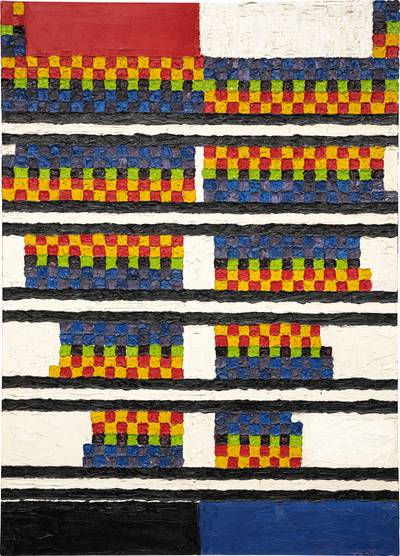
![Alfred Jensen — Outside Inside/inside In [in 2 Parts]](https://rtwaymdozgnhgluydsys.supabase.co/storage/v1/object/public/artwork-images/auction-lots/N10028-20190222-lot402.jpg)
Alfred Jensen
Outside Inside/inside In [in 2 Parts]
More recently, artists such as Hilma af Klint have been celebrated for synthesizing spiritual and scientific frameworks into visual form, and this reassessment has inevitably cast fresh light on Jensen, who was doing something equally radical and equally rigorous decades earlier. He deserves to be named in the same breath as these canonical figures. Alfred Jensen died in 1981, leaving behind a body of work that has grown in stature with every passing decade. His paintings now appear in the permanent collections of major institutions including the Guggenheim Museum and the Museum of Modern Art, and scholarly interest in his synthesis of ancient cosmologies, color science, and mathematical structure continues to deepen.
In an era when collectors and institutions alike are drawn to artists who challenge the boundaries between disciplines, who treat painting as a form of thinking rather than merely a form of making, Jensen stands as a foundational figure whose full importance is still being measured. To collect his work is to participate in one of the most genuinely original conversations that twentieth century art produced.
Explore books about Alfred Jensen