Alex Katz

Alex Katz, America's Master of Radiant Presence
Artist Spotlight · The Collection Editorial
“I want the painting to hit you before you have time to think about it.”
Alex Katz, interview
At ninety seven years old, Alex Katz shows no signs of slowing down. His recent exhibitions at Gavin Brown's Enterprise and continued representation by Gladstone Gallery have kept him firmly at the center of contemporary art conversation, while retrospectives at institutions including the Guggenheim Bilbao and Tate St Ives have introduced his work to entirely new generations of admirers. In 2022 and 2023, auction houses reported continued strength for his paintings and works on paper, with collectors drawn to the freshness and confidence that has defined his practice across seven decades. Few living artists can claim such sustained critical and commercial relevance, and fewer still continue to produce work that feels genuinely alive.

Alex Katz
Orange Hat (Alex and Ada), 1990
Katz was born in Brooklyn, New York in 1927 and grew up in St. Albans, Queens, the son of Russian Jewish immigrants who brought with them a seriousness about culture and ideas. He studied at the Cooper Union in New York from 1946 to 1949, receiving a rigorous grounding in drawing and design, before spending a pivotal summer at the Skowhegan School of Painting and Sculpture in Maine in 1949 and 1950. Maine would become a lifelong touchstone, the landscape there feeding an ongoing series of plein air works that capture light, water, and foliage with deceptive economy.
These early summers gave him an intimate relationship with the natural world that would counterbalance his equally strong pull toward the urban and the social. The New York art world Katz entered in the early 1950s was dominated by Abstract Expressionism, and the pressure to paint large, emotional, gestural canvases was considerable. Katz absorbed the scale and ambition of that movement while quietly moving in a different direction altogether. He was interested in the figure, in faces, in the specific quality of afternoon light on a group of friends gathered on a porch.
Alex Katz
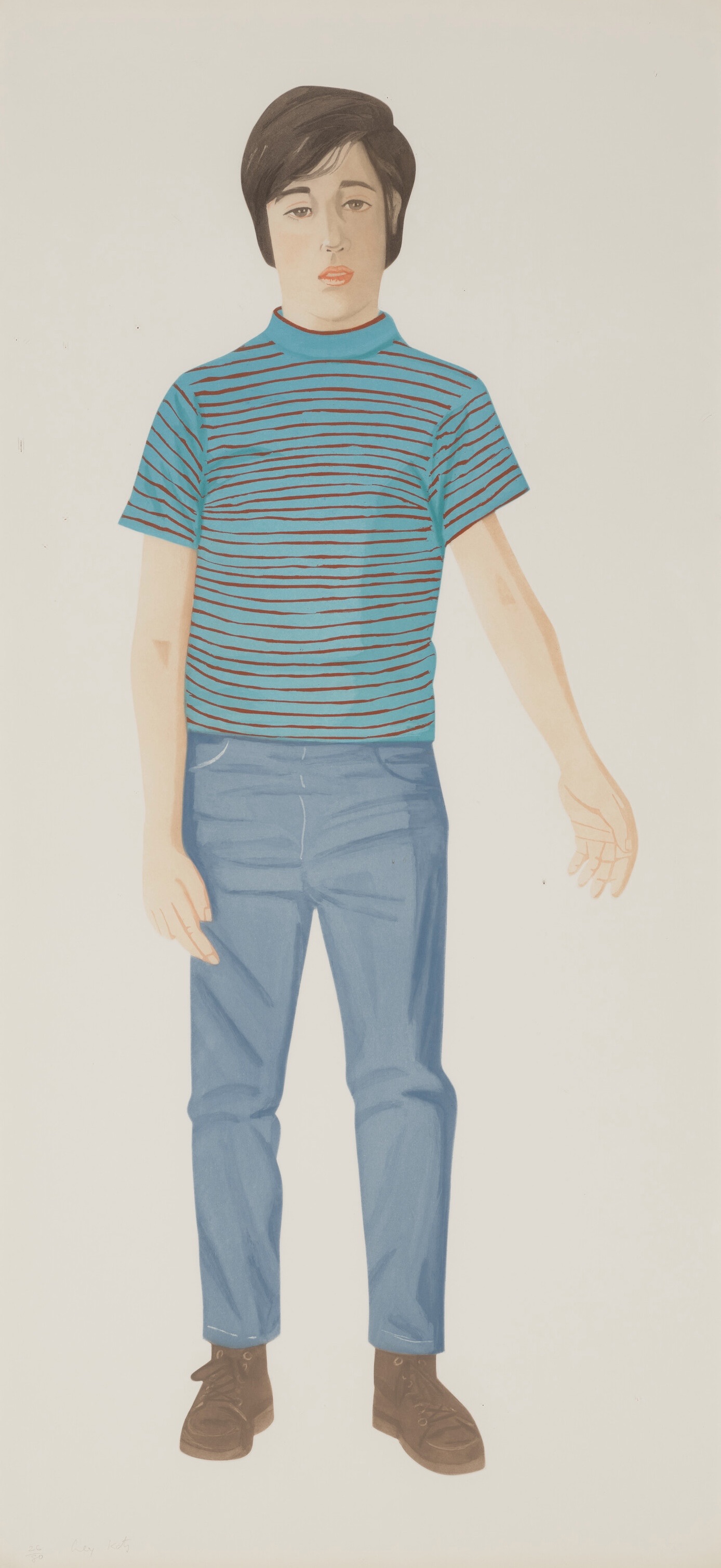
The Striped Shirt, 1980
By the late 1950s and into the 1960s, he had developed the bold, flat, graphic style that would become his signature: forms stripped of shadow and modelling, contours made clear and decisive, color applied in smooth, confident fields. Works like "East Madison No. 3" from 1960 show this language already fully formed, intimate in scale but assured in vision. He was not illustrating the world so much as translating it into something faster and more immediate.
“Style is when you do something more than once.”
Alex Katz
Katz developed his practice during the same years that Pop Art was emerging, and there are genuine affinities with artists like Andy Warhol and Roy Lichtenstein in his embrace of flatness, commercial graphic clarity, and the aesthetics of advertising and cinema. Yet his project was always more personal and more lyrical than Pop's cool irony suggested. His recurring subjects, his wife Ada, his artist friends, the beaches and marshes of coastal Maine, the elegant social world of New York, carry emotional weight without sentimentality. The large scale portraits for which he is best known command rooms and command attention.
Alex Katz
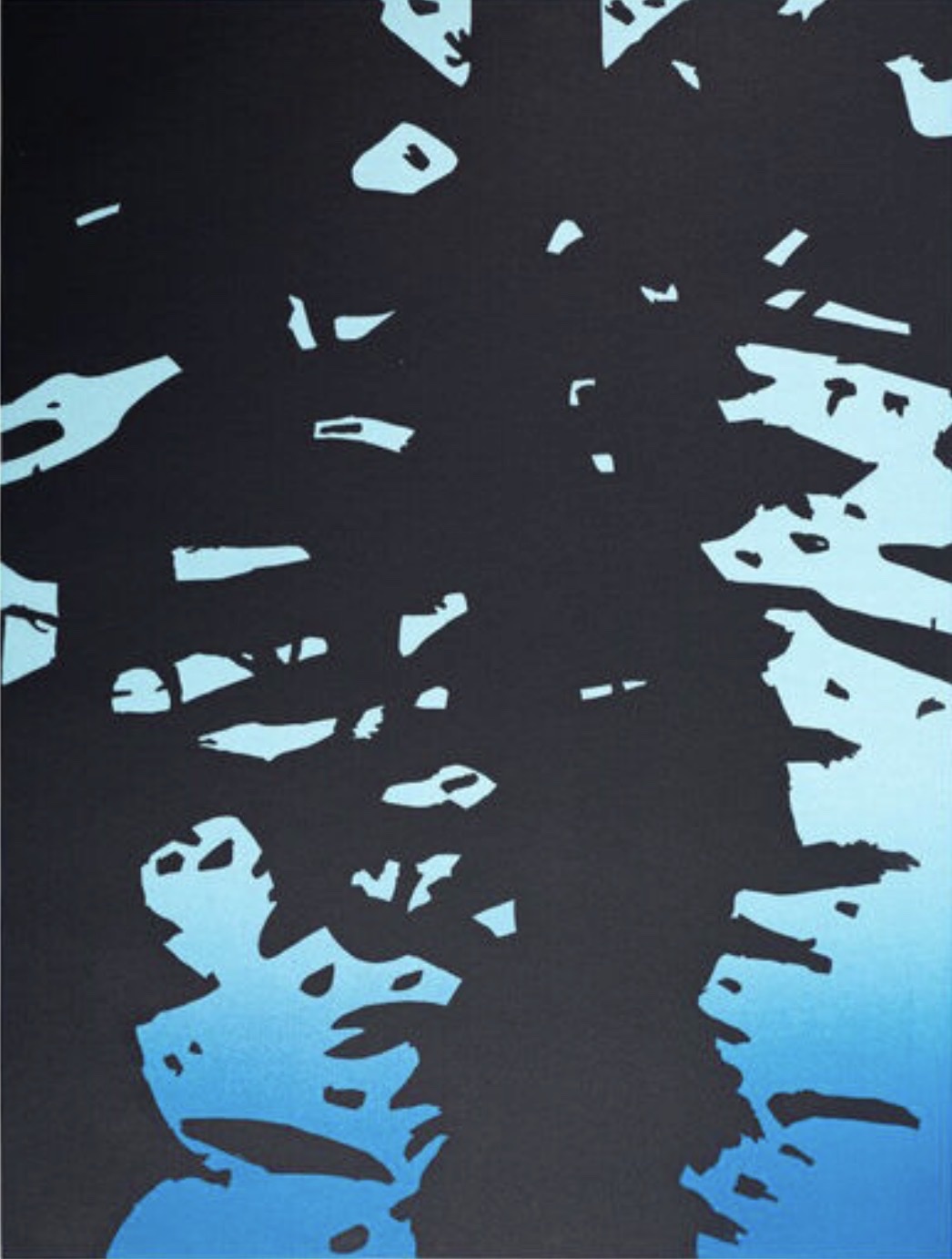
Reflection II, 2011
A face painted at ten times life size becomes something monumental and intimate at once. "Orange Hat" from 1990, depicting both Alex and Ada, is among the most beloved works in this vein, tender and graphic in equal measure. "The Striped Shirt" from 1980, rendered as an aquatint in colors on Arches Cover paper, demonstrates how fluently his language translates across print media, the flatness of the painted surface finding its natural equivalent in the discipline of printmaking. For collectors, Katz represents one of the most compelling propositions in postwar American art.
His work spans oil paintings on canvas and board, large shaped aluminum cutouts screenprinted on both sides, prints across every major medium including lithography, etching, and aquatint, and drawings that are sought after for their economy of line. The shaped aluminum multiples, works like the "Jessica" cutout with its bronze stand and weathervane edition, occupy a uniquely playful corner of his practice, sculptures that are also portraits, objects that somehow manage to feel both public and intimate. Entry points exist at many price levels, making Katz one of the more accessible blue chip names for collectors building a serious collection. Works on paper and prints offer genuine engagement with his visual ideas at a scale appropriate for domestic spaces, while major paintings have achieved significant results at auction and continue to appreciate steadily.

Alex Katz
Smap Maple 2, 1970
The consistency of his market reflects the consistency of his vision. To understand Katz fully it helps to place him in relation to his contemporaries and his inheritors. He shares with Fairfield Porter, another great figurative painter working against the Abstract Expressionist tide, a commitment to observed life rendered with formal rigor and genuine affection. Like Porter, he was championed by the poet and critic Frank O'Hara and found his early community among the New York School poets, a friendship that shaped the social warmth embedded in so much of his work.
Looking forward, his influence is evident in the work of artists including Elizabeth Peyton, Cecily Brown, and John Currin, all of whom have spoken about his importance as a model for ambitious figurative painting at a time when abstraction held cultural dominance. Katz showed that the figure could be modern, flat, and formally serious all at once. What Katz ultimately offers, to viewers and to collectors alike, is something rarer than technical virtuosity or art historical significance, though he possesses both. He offers a way of paying attention.
His paintings insist on the beauty of a specific gesture, a particular shade of green on a summer afternoon, the geometry of a social gathering, the light on a familiar face. Across more than seventy years of sustained practice, through movements and countermovements, through fashions that dismissed the figure and fashions that reclaimed it, he has held to a vision that is generous, joyful, and entirely his own. The breadth of work available through The Collection reflects the full range of that vision, from early oil studies on board to major print editions to the iconic shaped cutouts, offering collectors the rare opportunity to engage deeply with one of the defining American artists of the twentieth and twenty first centuries.
Explore books about Alex Katz