Alessandro Sicioldr
Alessandro Sicioldr Illuminates the Dreaming Soul
Artist Spotlight · The Collection Editorial
There is a particular kind of quietude that falls over a room when Alessandro Sicioldr's paintings are present. Visitors to his recent exhibitions across Europe have described the experience in strikingly similar terms: a slowing of breath, a sense that the figures on canvas are watching back with the patient knowledge of something older than language. That quality, at once unsettling and deeply tender, has made the Tuscan born painter one of the most genuinely compelling voices to emerge from Italian figurative art in the past decade. Collectors who encountered his work early speak of it with the particular proprietary warmth reserved for artists they feel they discovered before the world caught up.
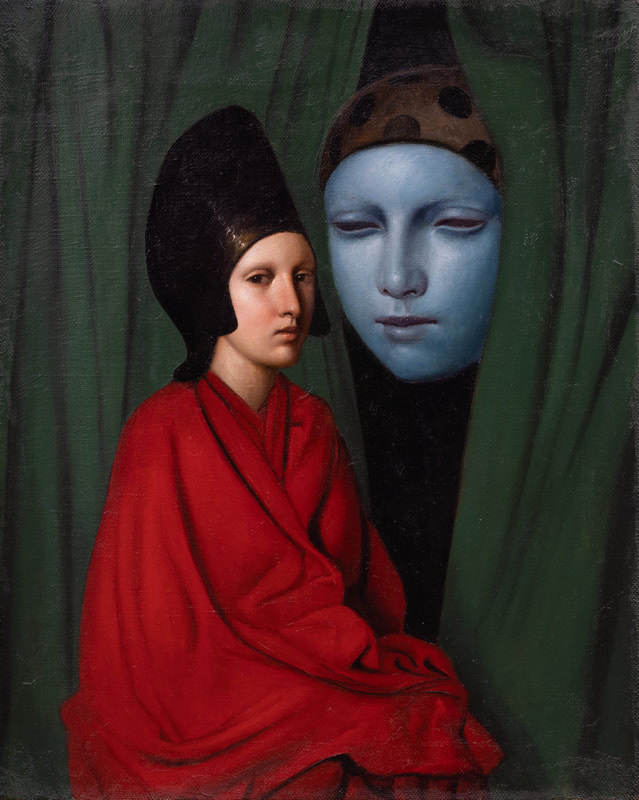
Alessandro Sicioldr
Custode, 2022
Sicioldr was born in 1989 in Tuscania, a small hilltop town in the northern reaches of Lazio, a landscape dense with Etruscan history and the kind of ancient stone light that seems to filter time rather than simply illuminate it. His formation was unusually intimate and direct: he learned to paint in his father's studio, absorbing methods and materials through proximity and practice rather than through formal academic instruction alone. That apprenticeship model, more Renaissance than contemporary, gave him an early fluency with oil paint, linen, and wooden panel that many of his peers would spend years trying to acquire. It also gave him a particular relationship to tradition, not as a constraint but as a living conversation.
The influences that animate his canvases are drawn from a remarkable range of historical currents, and part of what makes Sicioldr so intellectually satisfying is the precision with which he has synthesized them. From Surrealism he inherits the logic of the irrational, the understanding that the psyche operates according to its own compelling rules and that painting is a worthy instrument for their exploration. From Symbolism he draws the dreamlike atmosphere, the sense that every image carries a second register of meaning that shimmers just beneath its surface. And from the Mannerist tradition and the great Flemish masters he takes something perhaps most rare in contemporary painting: a devotion to light, to minute detail, and to the kind of chromatic subtlety that rewards sustained, close looking.
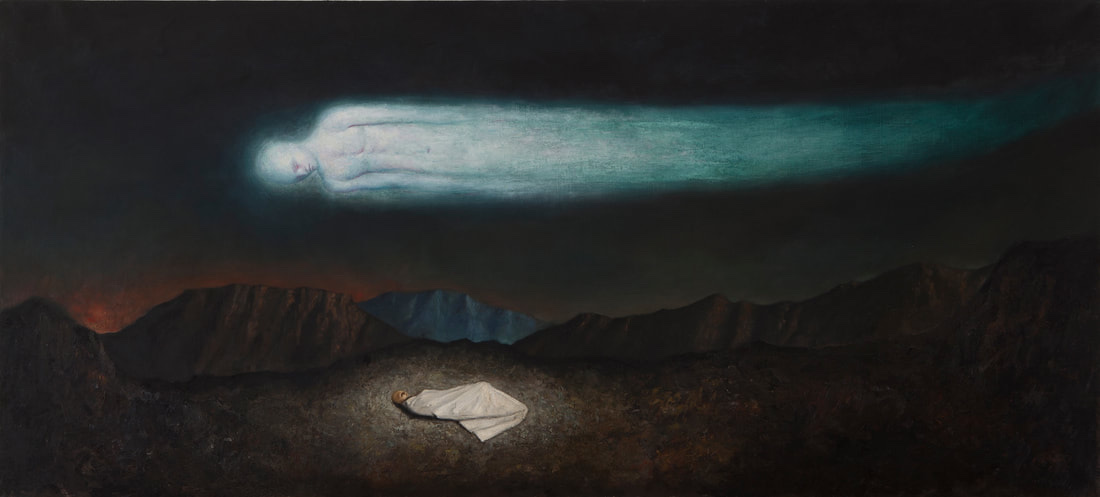
Alessandro Sicioldr
Epifania Del Candore, 2019
Artists such as Jan van Eyck and Hans Memling cast long shadows across his practice, as do the elongated spiritual intensities of Pontormo and Rosso Fiorentino. His artistic development has moved with the confidence of someone who has always known, broadly, where he is going while remaining genuinely open to what each canvas teaches him. His early panel paintings, including works from 2017 such as "Il Matto" and "The Annunciation or The Red Room 1" and "Il Poeta o l'Enigma della Cattedrale," established his signature territory immediately: solitary figures suspended in spaces that belong to no particular time, their expressions carrying the gravity of ritual and the softness of reverie. The use of wood panel in this period connects him explicitly to the Northern European tradition, and the paintings carry the jeweled density that medium demands.
By 2018, with works like "La Visita" and "Ophelia's Dream," he had moved toward linen as his primary support, and the paintings breathed a little differently as a result, the light becoming more atmospheric, the dreamlike quality more suffused. The paintings that mark his maturity represent some of the most quietly arresting figurative work being made anywhere today. "Epifania Del Candore" from 2019 is a work of startling purity, a meditation on whiteness and revelation that earns its title without ever illustrating it. "La Prova" from 2021 carries the weight of examination and endurance in every square centimeter of its surface.
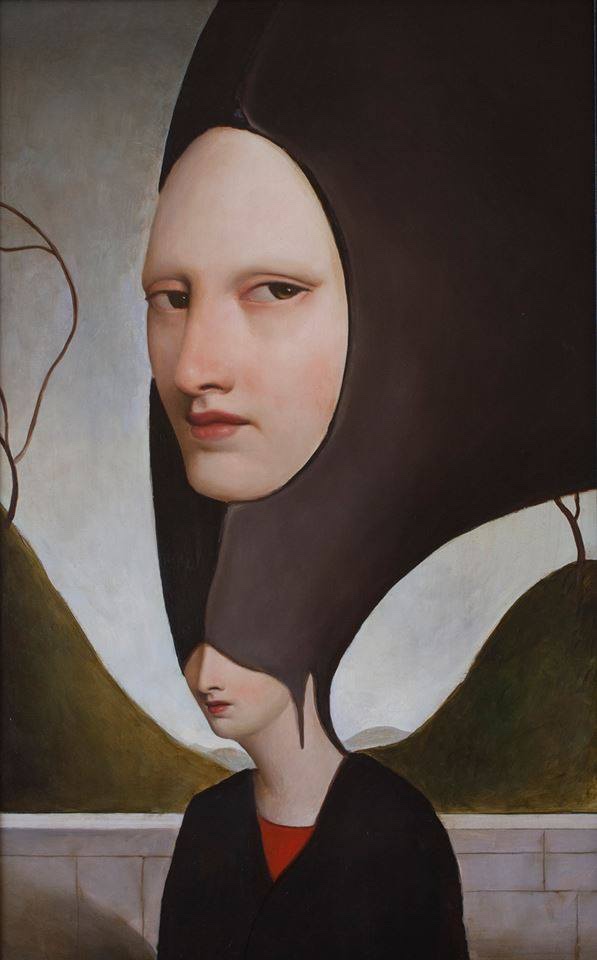
Alessandro Sicioldr
Il Matto, 2017
And the group of works from 2022, including "Custode," "Annuncio," and "Re Blu," demonstrate an artist at the height of his powers, integrating all of his influences into something that feels entirely and irreducibly his own. "Custode," meaning guardian, is perhaps his most distilled statement to date: a figure whose role is protection rendered with a stillness so complete it becomes sacred. These are paintings that ask you to sit with them, and they reward that patience generously. For collectors, Sicioldr presents an opportunity that comes along only rarely: an artist whose technical achievement is already at a very high level, whose conceptual coherence is genuine rather than constructed, and whose market profile is still at a stage where serious works remain accessible.
His paintings belong to a tradition of Northern and Central European panel and canvas painting that has always found devoted institutional and private collectors, and there is a clear line of affinity between his work and that of artists like Odd Nerdrum, Roberto Ferri, and the broader contemporary revival of classical and symbolic figurative painting that has been gaining institutional recognition across Europe and North America. What distinguishes Sicioldr within that company is the particular quality of his interiority: his paintings are not theatrical or performative but genuinely contemplative, more Flemish altarpiece than salon showpiece. Within the larger sweep of art history, his practice participates in a conversation about what figurative painting can still do, what territories of human experience it is uniquely equipped to map. The Symbolist painters of the late nineteenth century, artists such as Fernand Khnopff and Jan Toorop, understood that painting could be a form of psychological cartography, a way of rendering the interior landscape visible.
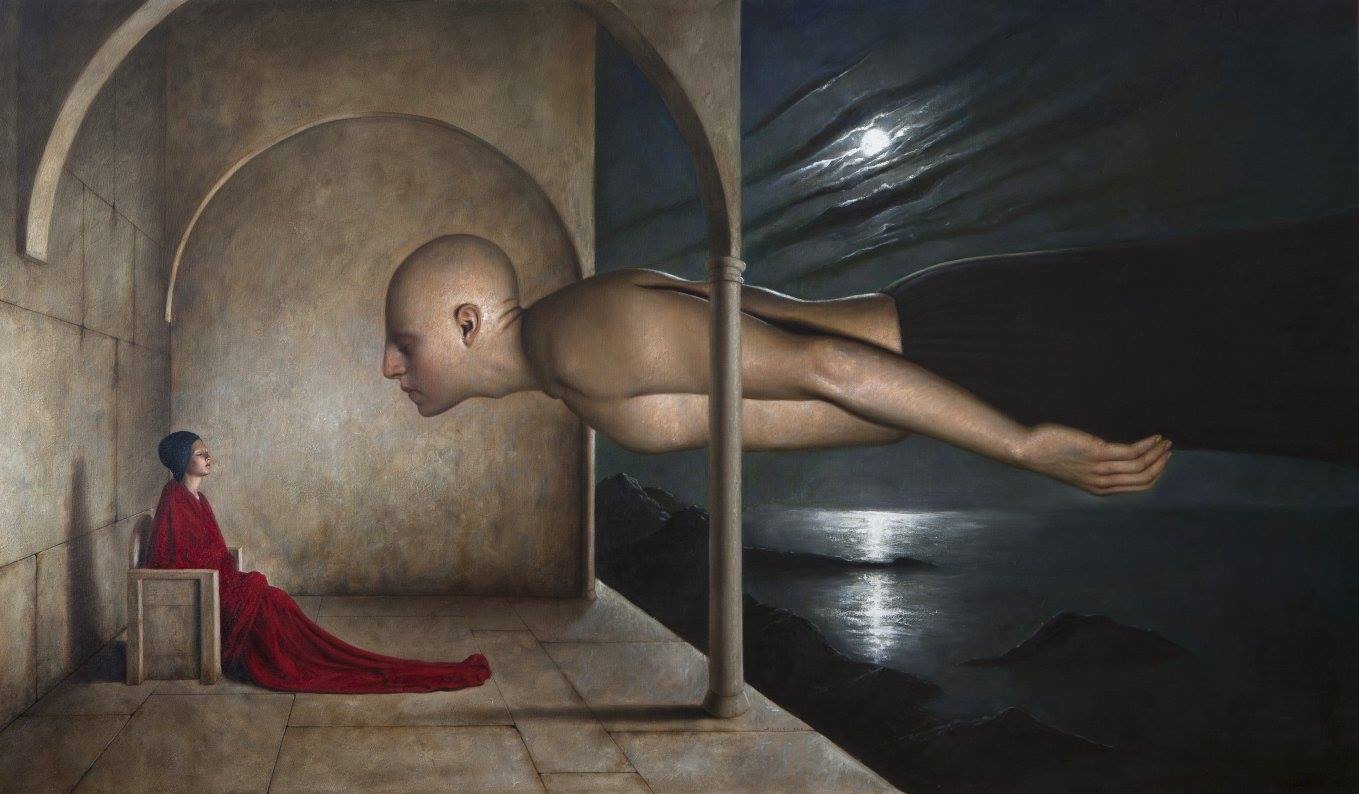
Alessandro Sicioldr
La Visita, 2018
The Surrealists, particularly those with a more painterly sensibility like Paul Delvaux or Leonor Fini, extended that project into the territory of the unconscious. Sicioldr inherits both strands and adds to them the discipline and material seriousness of the old masters. The result is a body of work that feels simultaneously ancient and urgently contemporary. What matters most about Alessandro Sicioldr, as both the art world and the collecting community continue to take fuller notice of his achievement, is the quality of sustained attention he brings to every canvas and the quality of sustained attention his canvases in turn demand from us.
In an era that often prizes immediacy and legibility, he makes paintings that unfold slowly, that deepen with repeated looking, and that carry genuine emotional weight without ever straining for it. To own a Sicioldr is to have a quiet interlocutor on your wall, one who speaks in the language of dreams and memories and the long history of paint on surface. That is a rare thing, and it is worth cherishing.