Affandi
Affandi: Paint, Passion, and Pure Feeling
Artist Spotlight · The Collection Editorial
“I am not an Expressionist. I just paint what I feel.”
Affandi
There is a moment, preserved in photographs taken at his studio compound in Yogyakarta, when Affandi Koesoema is not so much painting as conducting. His hands move across a canvas propped directly on the floor, fingers dragging thick ropes of color squeezed straight from the tube, his entire body bent into the work as though the image is being pulled from somewhere deep inside him. That studio, a pair of organic, shell shaped structures he designed himself along the banks of the Gajah Wong River, still stands today as the Affandi Museum, a pilgrimage site for lovers of modern Indonesian art and a testament to how completely this painter fused his life and his practice into a single, inseparable force. Affandi was born in 1907 in Cirebon, a port city on the north coast of West Java long known as a crossroads of Javanese, Chinese, and Islamic cultural influence.
Affandi
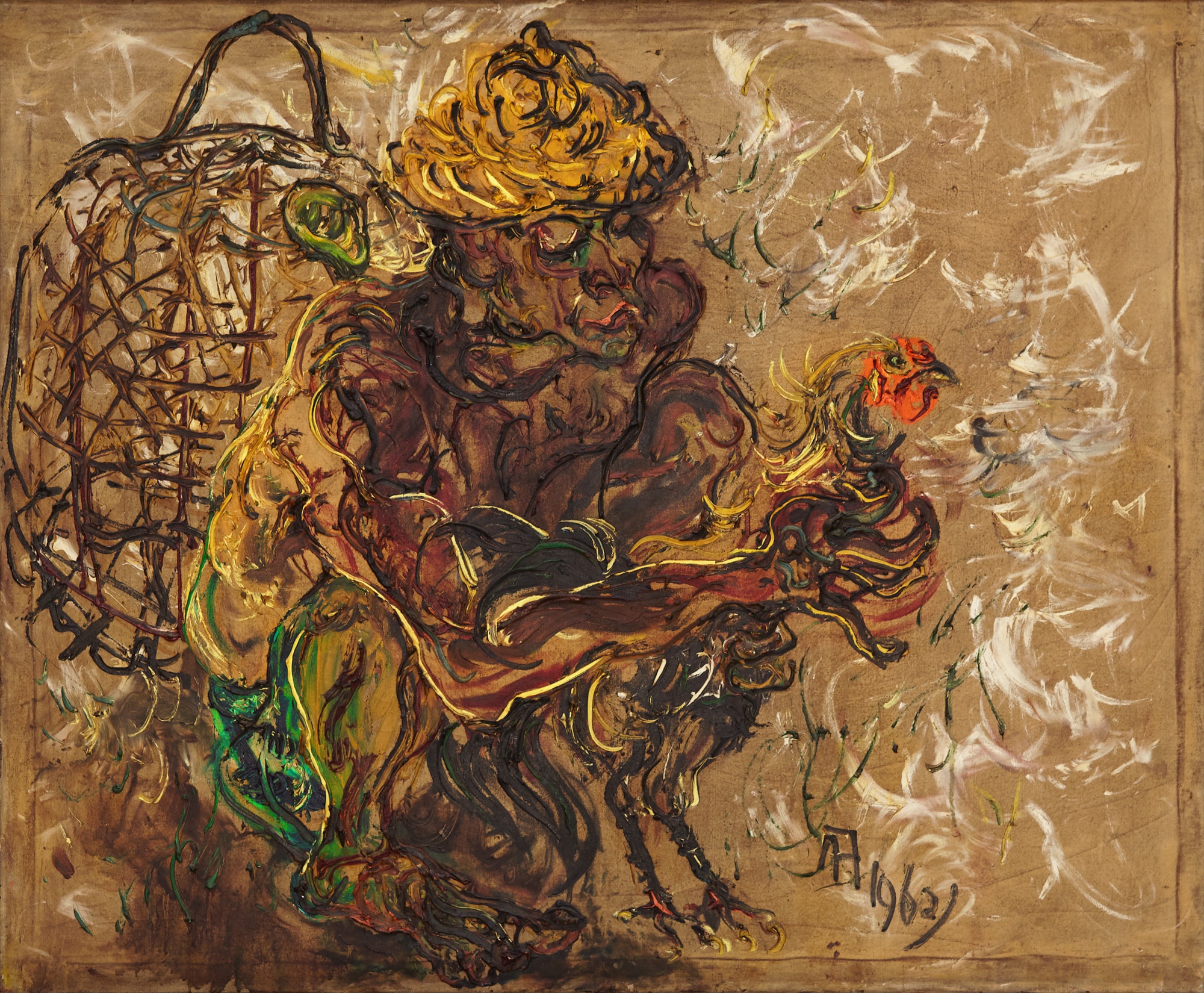
Man with cockerel 男人與公雞, 1960
His early years were modest, and he came to painting not through formal privilege but through an almost feverish self determination. He worked as a sign painter, a cinema billboard artist, and a school art teacher before his talent found its full expression. These early working roles were formative: they gave him a sense of painting as a physical, public, even democratic act rather than a refined academic exercise, and that attitude would mark his work for the rest of his life. In the 1940s, as Indonesia moved through the tumultuous years surrounding independence, Affandi was already developing the visceral approach that would eventually make him famous far beyond the archipelago.
He began showing internationally in the 1950s, exhibiting in India, Europe, and the United States at a time when very few Southeast Asian artists were being taken seriously in those contexts. His 1955 participation in the São Paulo Biennial and his subsequent travels through Europe brought him into contact with the great currents of postwar Expressionism, though Affandi had by then already arrived at something comparable through his own instinct. Critics sometimes reached for comparisons to Van Gogh or Oskar Kokoschka, and the formal resemblances are real, but Affandi's emotional register is entirely his own: warmer, more rooted in sensory pleasure and communal life, less tormented in its underlying worldview. The technique that defines him is at once immediately recognizable and genuinely difficult to master.
Affandi
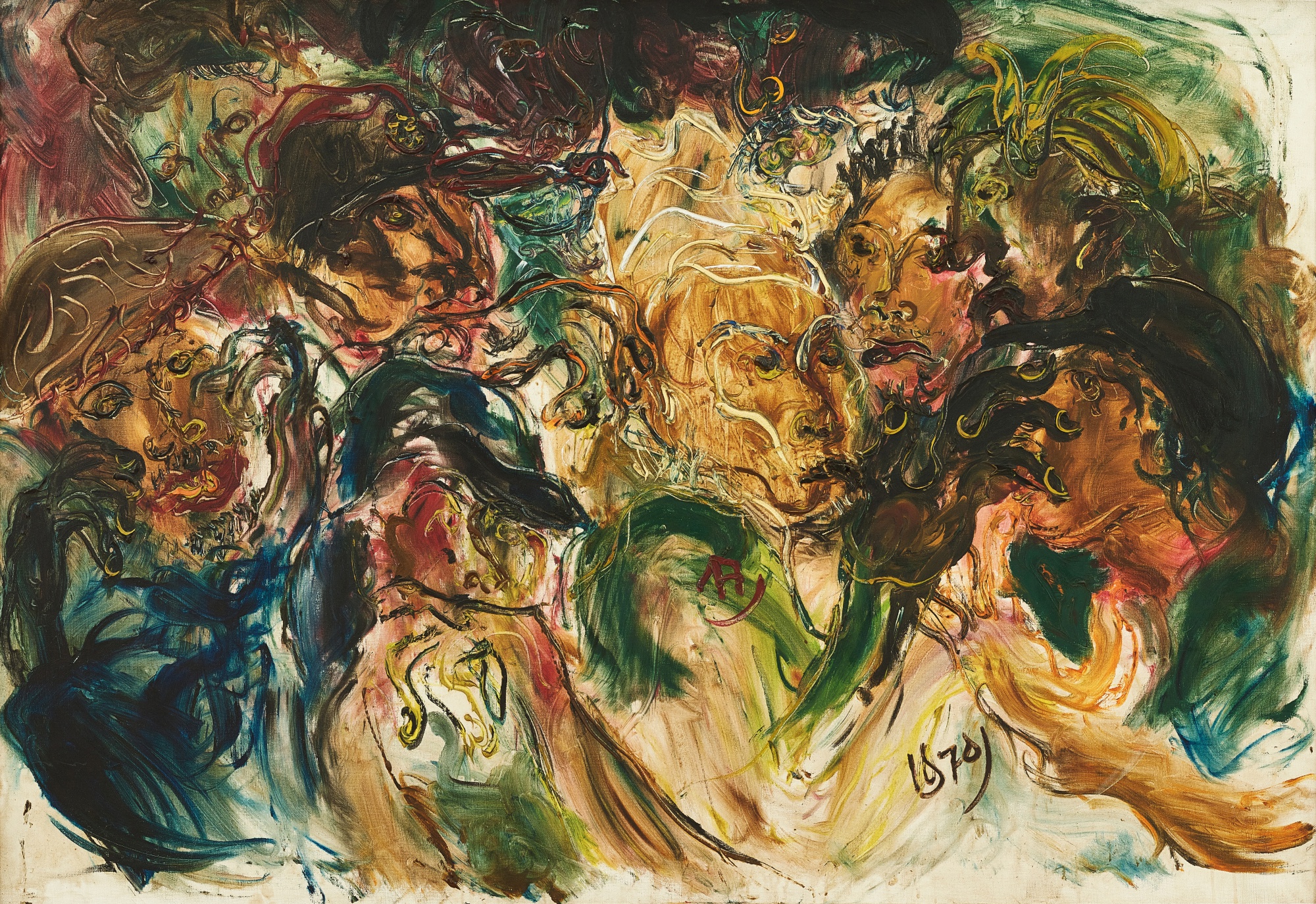
Watchers at a cockfight 觀看鬥雞的人, 1970
By squeezing paint directly from the tube and working it with his palms, knuckles, and fingernails, Affandi eliminated the mediation of the brush and with it any possibility of deliberate correction or refinement. The result is a surface that records every decision in real time, every surge of feeling made permanently visible. Works such as Man with Cockerel from 1960 and Watchers at a Cockfight from 1970 demonstrate this with particular force: the figures seem to vibrate, almost unstable on the canvas, caught in a moment of collective intensity. The cockfight, a subject he returned to across decades, was for Affandi not merely a colorful regional custom but a charged arena of male pride, risk, and animal energy that suited his painterly temperament exactly.
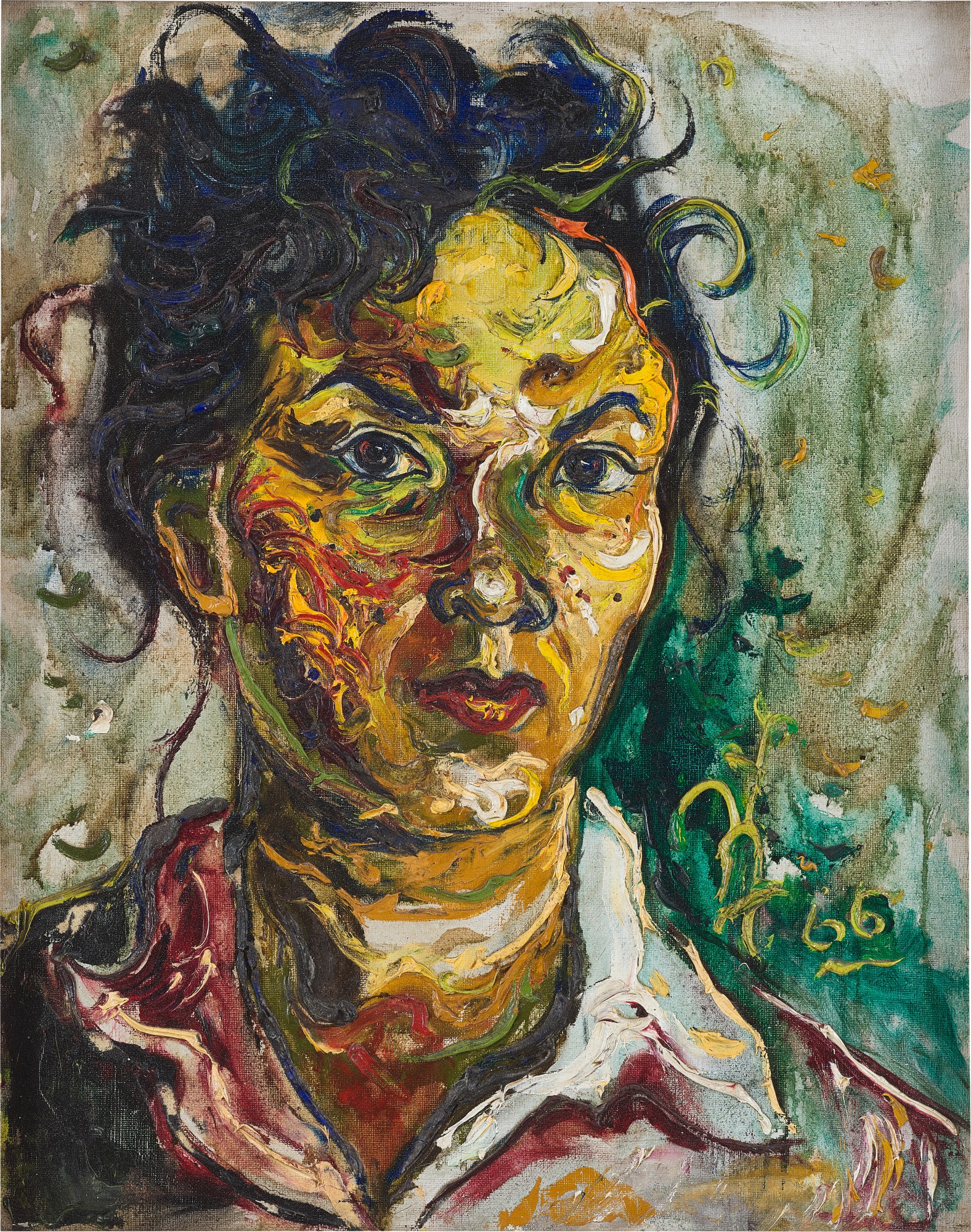
Similarly, The Fisherman from 1975 transforms a simple laboring figure into something monumental, the body described in arcs of impasto that feel as muscular as the work being depicted. Portraiture occupied a special place in his output throughout his career. His Portrait of Kartika Affandi, depicting his daughter who would herself become a celebrated painter, is among the most tender works in his catalogue, showing that the same technique capable of raw, almost violent energy could also yield extraordinary intimacy. The Balinese subjects he explored repeatedly, including Barong from 1973 and the Jauk Manis Dancer from 1979, reveal his deep affinity with the ceremonial and the theatrical, with bodies in states of heightened spiritual or performative consciousness.
Affandi
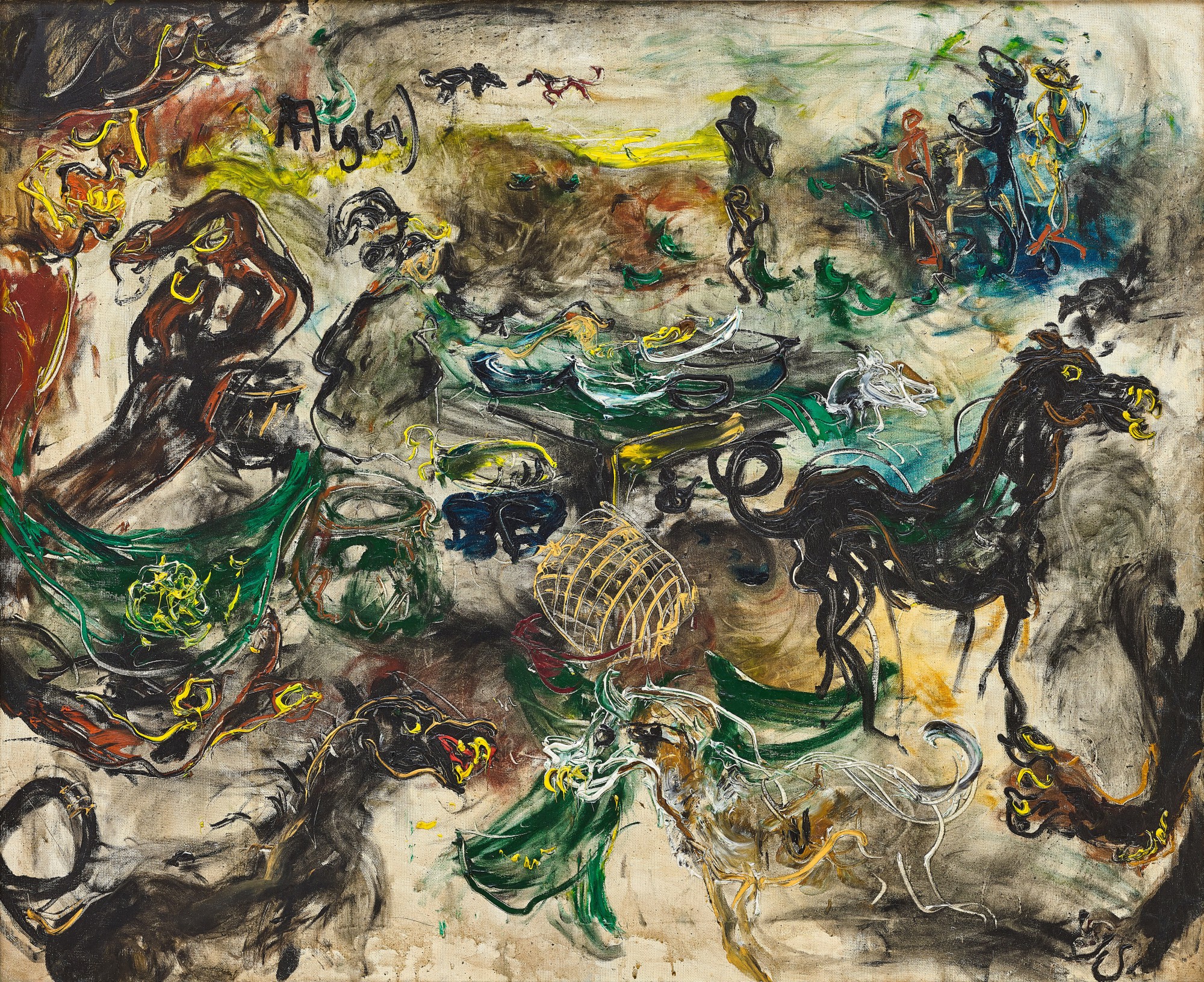
Everyday Living 日常生活
Bali was not merely an exotic backdrop for Affandi but a place whose visual culture resonated with his own belief that art should be felt before it is understood. For collectors, Affandi represents one of the most compelling propositions in the entire field of Southeast Asian modernism. His works have appeared consistently at major auction houses across Singapore, Hong Kong, and Jakarta, with significant pieces achieving results that reflect growing international recognition of his stature. Christie's and Sotheby's sales in Singapore have seen Affandi canvases attract serious bidding from collectors across Asia, Europe, and beyond, and the market has shown a steady appreciation that rewards early and knowledgeable acquisition.
What distinguishes the most sought after works are scale, the directness of the subject, and above all the legibility of his distinctive process: one should be able to feel, looking at a genuine Affandi, that the painting happened in a rush of concentrated life. Works from his mature period between the late 1950s and the 1980s are generally considered his strongest, combining technical authority with the full emotional range his method could produce. Within the broader history of twentieth century art, Affandi occupies a position analogous in some ways to that of artists like Chaim Soutine, whose expressionist handling and intense emotional directness also resisted absorption into any single school or movement. In the context of Asian modernism specifically, he belongs to a generation that includes the Filipino painter Victorio Edades and the Indian painter F.
Affandi
Portrait of Kartika Affandi 卡迪卡·阿凡迪肖像
N. Souza, artists who developed powerful individual voices while navigating the competing pressures of nationalist sentiment, Western modernism, and their own vernacular traditions. What sets Affandi apart even within that distinguished company is the radical consistency of his commitment: he did not move through styles or experiment with abstraction as a way of claiming modernity. He found his method and he deepened it across five decades, returning again and again to the human figure, to the rituals of daily life, to the faces and working bodies of the people around him.
Affandi died in Yogyakarta in 1990, leaving behind a body of work that has only grown in stature and in market importance in the decades since. His museum remains one of the most visited cultural sites in Central Java, and the continuing influence of his approach can be felt in generations of Indonesian painters who came after him. To encounter his paintings in person is to understand immediately why he inspired such devotion: the surfaces are alive with a kind of concentrated physical presence that photographs only partially convey. He painted as though each canvas might be the last, and that urgency, that complete surrender to the act itself, is what makes him not merely a great Indonesian artist but a genuinely significant figure in the global story of modern painting.
Explore books about Affandi

Affandi: A Retrospective
Kuswaji Kuswaji
Affandi: The Life and Work of Indonesia's Greatest Painter
Oemarsih Dwikarya
Affandi and Modern Indonesian Art
Astri Wright
The Paintings of Affandi
Sudarmaji
Affandi: Master of Expression
Bambang Sumadio