Ablade Glover
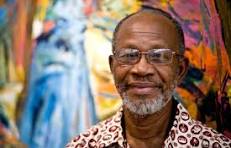
Ablade Glover, Ghana's Luminous Market Poet
Artist Spotlight · The Collection Editorial
In the grand sweep of African modernism, few painters have captured the pulse of everyday life with as much warmth, intelligence, and sheer painterly joy as Ablade Glover. Now in his tenth decade, the Ghanaian master continues to be celebrated across the continent and beyond, his canvases held in private collections from Accra to London and his influence felt in virtually every art institution that has taken West African visual culture seriously. A recent resurgence of global interest in African modernism, driven in part by major retrospectives at institutions including the Smithsonian and significant sales at Bonhams and Sotheby's African art auctions, has brought fresh eyes to Glover's extraordinary body of work. For collectors who have long known his name, the moment feels overdue.
Ablade Glover
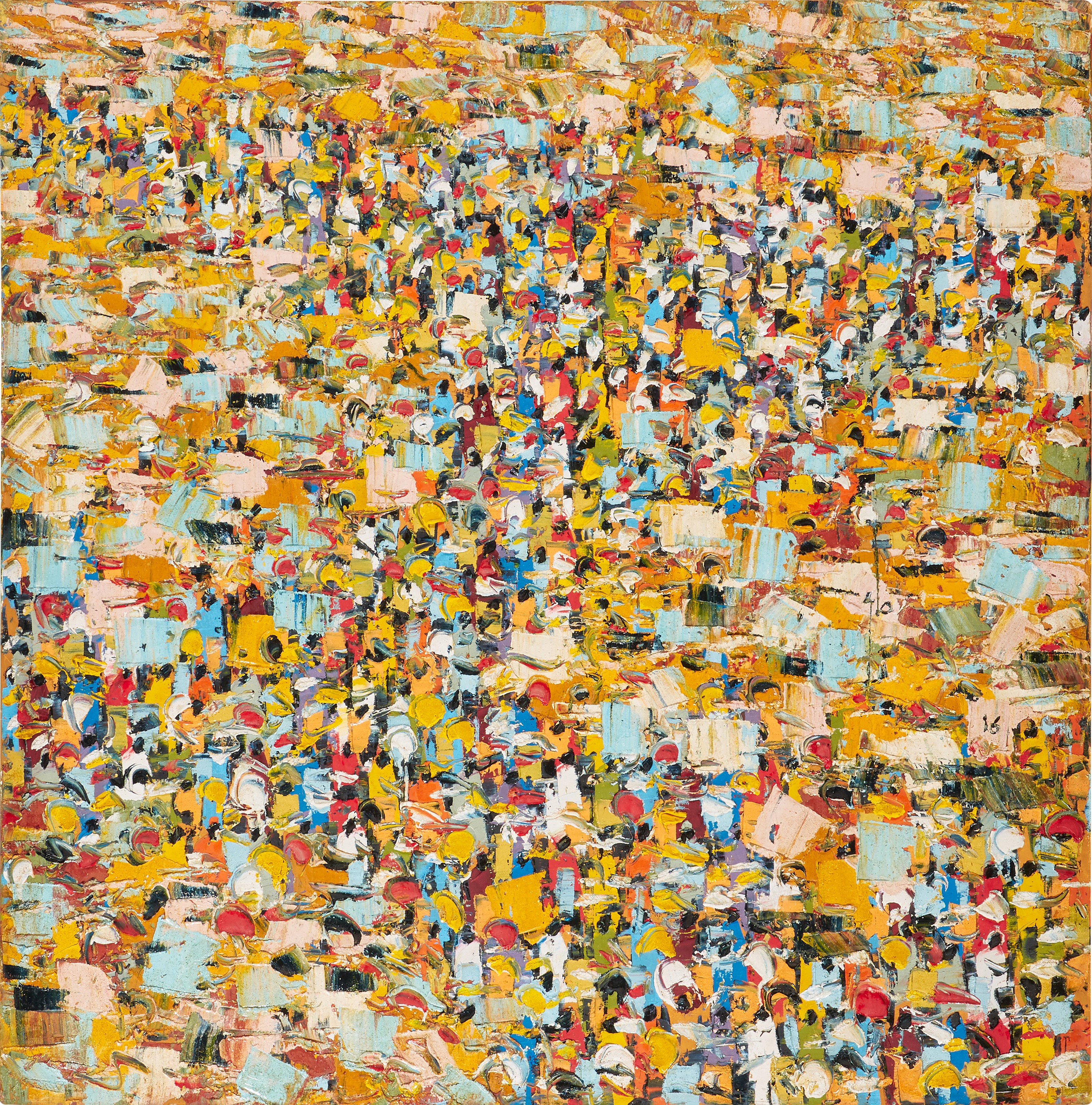
Market Lane
For those encountering him for the first time, it feels like a revelation. Glover was born in 1934 in Ghana, then the Gold Coast under British colonial rule, at a moment when the idea of a distinctly African visual art identity was still being fiercely imagined and argued over. His early formation took place against a backdrop of profound political and cultural transformation. Ghana's independence in 1957 under Kwame Nkrumah was not merely a political event but a declaration of cultural selfhood, and for a young artist coming of age in that atmosphere, the stakes of making art felt enormous and invigorating.
Glover pursued formal training with seriousness and ambition, eventually studying abroad before returning to Ghana to build an artistic life rooted in his own soil, his own people, and the riotous color of West African daily existence. His academic journey took him through rigorous training in Europe, where he encountered the great traditions of Western painting from the Impressionists through the Abstract Expressionists. But what is remarkable about Glover is how cleanly and deliberately he metabolized those influences and turned them into something entirely his own. The impasto technique that became his signature draws on the physical boldness of painters like Frank Auerbach or Leon Kossoff, but the spirit animating the paint is wholly Ghanaian.
Ablade Glover
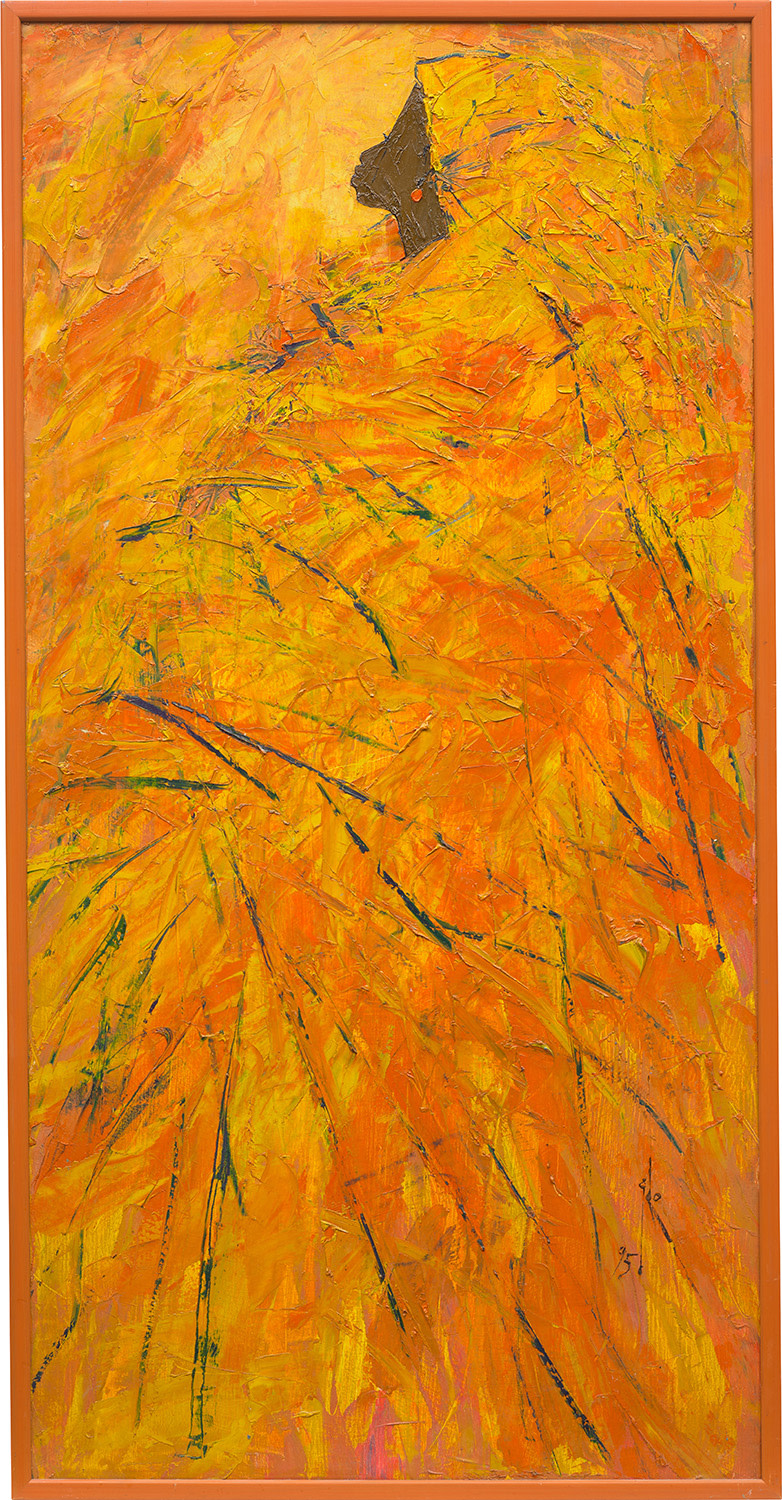
Orange Woman in Profile, 1995
Where those painters used texture to excavate psychological depth, Glover uses it to render light, movement, and communal energy. The surface of a Glover canvas is not a record of anguish but a celebration of presence. Returning to Ghana, Glover dedicated himself not only to his own practice but to the broader project of building visual arts culture in West Africa. He became a foundational figure at the College of Art at the Kwame Nkrumah University of Science and Technology in Kumasi, where he taught and shaped generations of Ghanaian artists.
His contribution to arts education in the region cannot be overstated. He understood that a thriving art scene required infrastructure, pedagogy, and institutional memory, not only the lone genius in the studio. This dual commitment, to making and to teaching, gives his legacy a texture that purely commercial careers rarely achieve. The works that define Glover's reputation are overwhelmingly drawn from the markets, streets, and courtyards of Ghanaian life.
Ablade Glover
View over a Village, Yellow Roofs
Pieces such as "Market Place" from 1988 and "Pot Dealers (Market Forms)" from 1990 are extraordinary examples of his mature method. The composition in these works is dense and democratic: no single figure dominates. Instead, the eye moves across a field of activity, drawn from seller to buyer to basket to cloth, the whole scene held together by Glover's luminous, sun saturated palette. "Orange Woman in Profile" from 1995, among his most quietly powerful works, zooms in close, finding the monumental within the everyday.
The woman at its center is unhurried and self possessed, rendered with a dignity that transforms a market portrait into something approaching icon. Later works such as "People" from 2018 demonstrate that his appetite for the subject remained undiminished well into his eighties, the paint applied with a confidence that only decades of practice can produce. For collectors, Glover presents a compelling proposition that sits at the intersection of art historical importance and aesthetic pleasure. His works are genuinely enjoyable to live with: the colors sing, the surfaces reward close looking, and the subjects carry an optimism that is intellectually honest rather than sentimental.
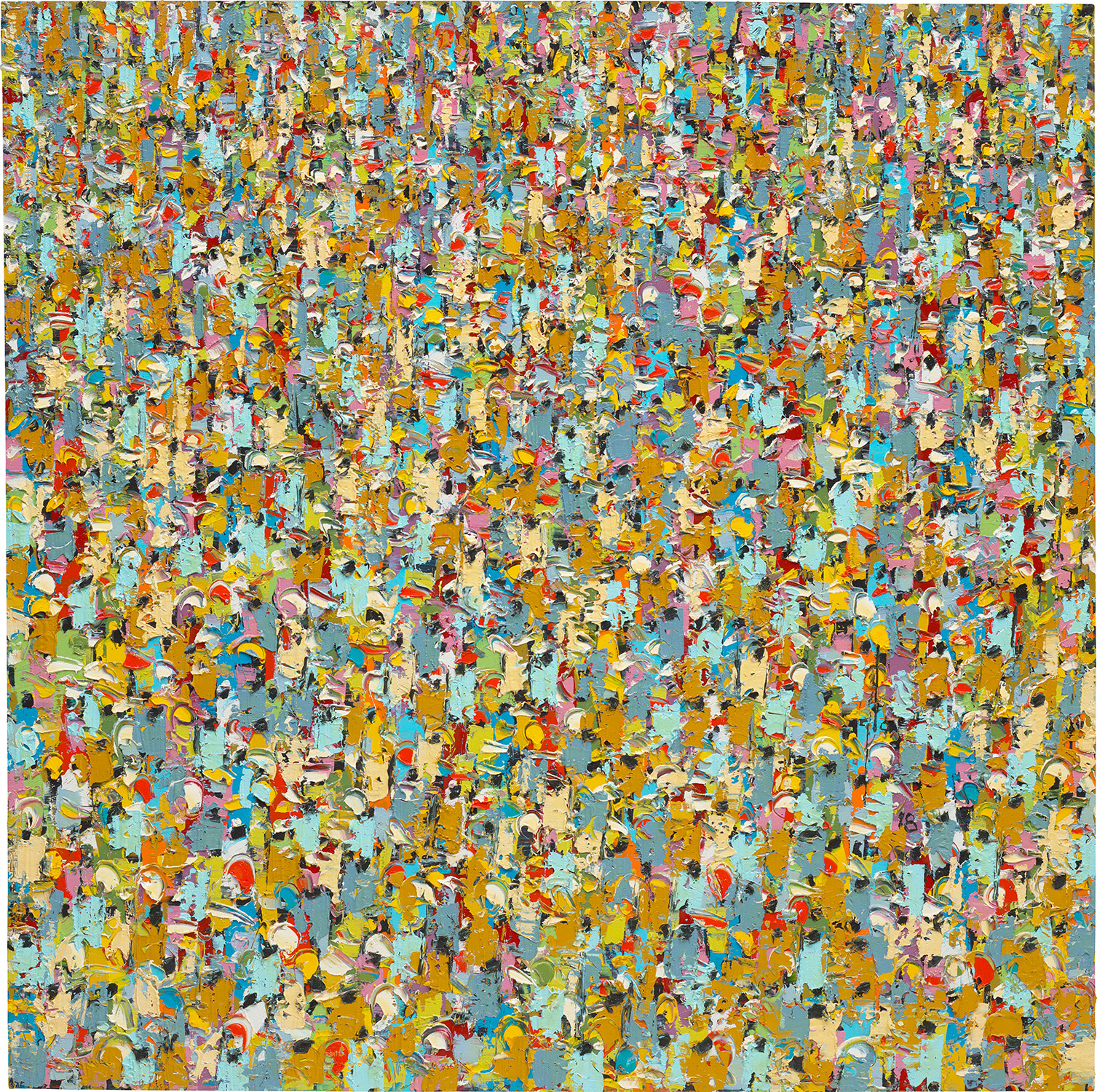
Ablade Glover
People, 2018
On the secondary market, Glover's canvases have attracted steady and growing interest, particularly among collectors focused on African modernism and those building broader collections of postwar international art who recognise his work as belonging to a global conversation. Collectors drawn to painters who work in the physicality of impasto, and who are also looking at figures such as the Nigerian painter Bruce Onobrakpeya or the South African Dumile Feni, will find in Glover a natural companion and counterpoint. Works on canvas in his signature market idiom, particularly those dated between the late 1980s and mid 1990s, represent a period of peak confidence and are increasingly sought after. Earlier works and those with documented exhibition history carry particular weight with serious collectors.
Glover's place in art history is assured, though the full scope of that place is still being established by curators and scholars catching up with what the market and a devoted community of private collectors have long understood. He belongs to a generation of African artists, alongside figures such as El Anatsui, Skunder Boghossian, and Uche Okeke, who built a genuinely postcolonial visual language without simply inverting Western models or retreating into an idealized African past. His work is rooted in the living present of the continent as he experienced it: noisy, warm, complex, and fundamentally human. That rootedness is what keeps his paintings from feeling like documents and ensures they remain living things.
To encounter a Glover painting today is to understand something essential about the ambition of African modernism at its best. It is also to encounter a specific and irreplaceable sensibility, a painter who looked at the world around him with curiosity and love and found in oil paint a medium capacious enough to hold all of it. As global collecting continues to widen its aperture and institutions accelerate their attention to artists long underrepresented in the canonical story of twentieth century art, Glover stands ready to be seen at the scale his work has always deserved. The paint is thick, the color is warm, and the light never quite fades.