Aaron Shikler
Aaron Shikler, Portrait Painter to the Ages
Artist Spotlight · The Collection Editorial
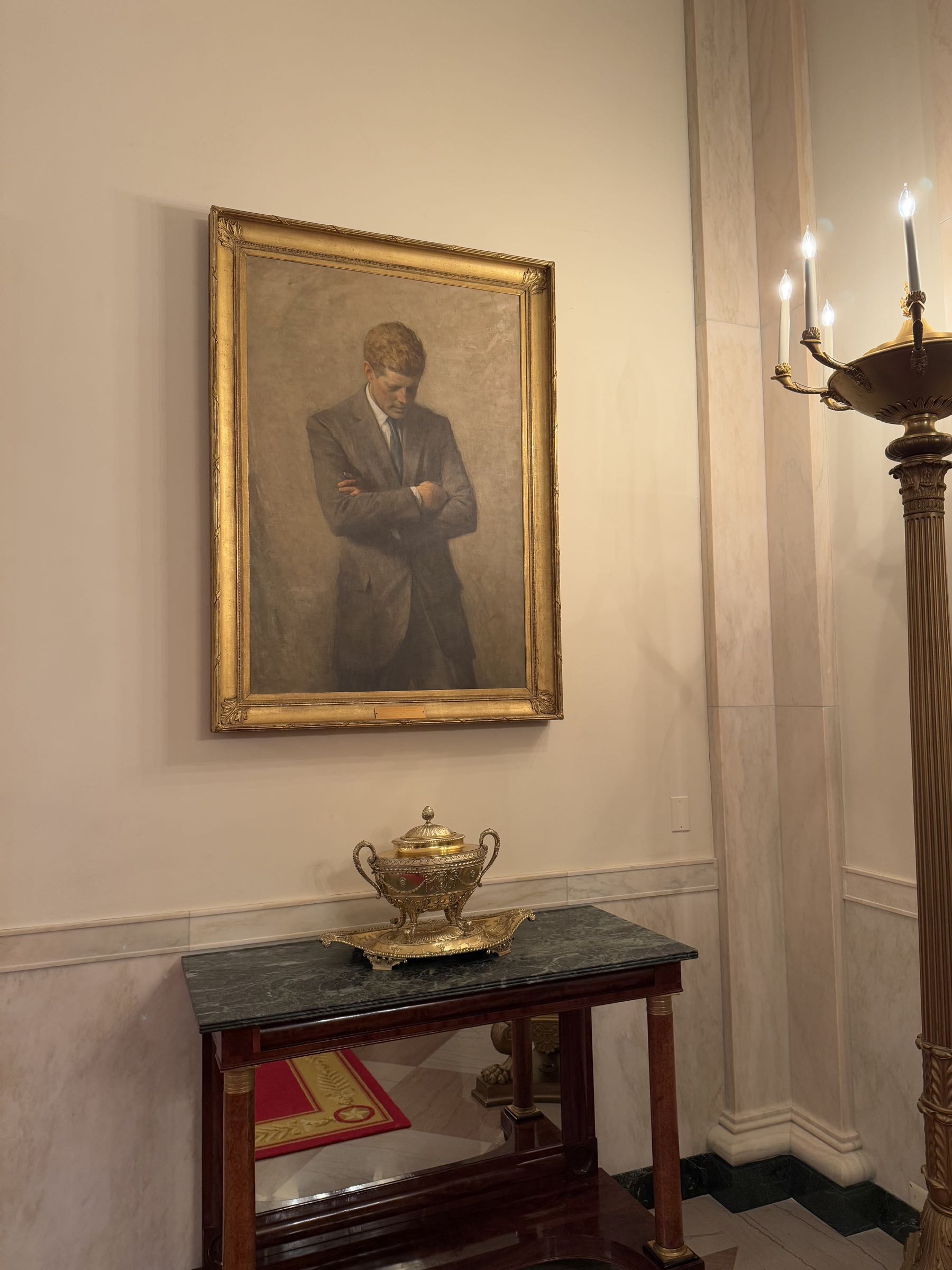
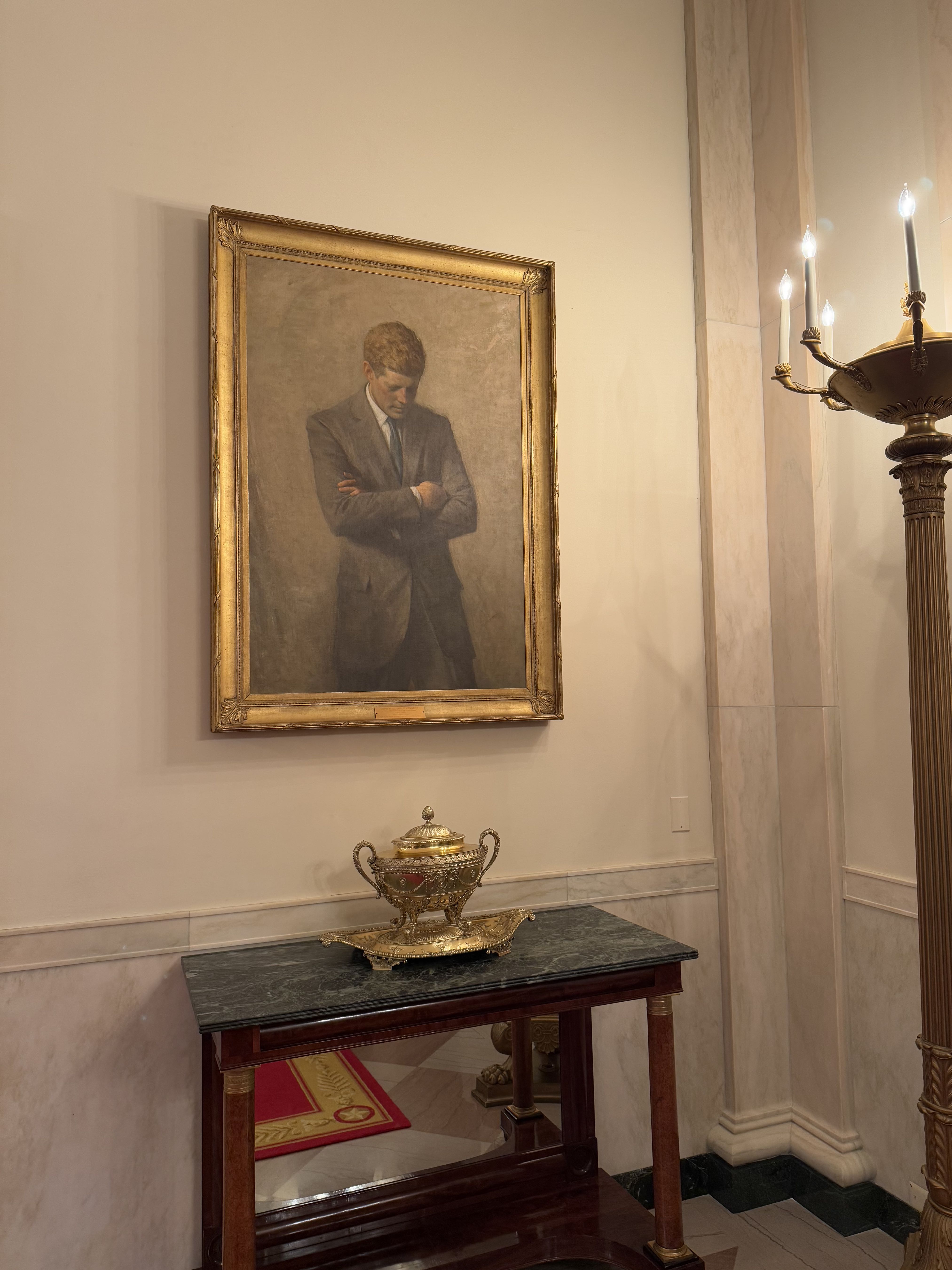
There is a painting that stops visitors in their tracks at the John F. Kennedy Presidential Library in Boston. Aaron Shikler's official portrait of the 35th President, commissioned in 1970 by Jacqueline Kennedy Onassis herself, does not show the young commander in chief in the confident, forward facing manner one might expect. Instead, Kennedy stands with his head bowed and arms folded, lost in contemplation, rendered in Shikler's signature warm palette with a tenderness that feels almost unbearably intimate.
Aaron Shikler
John F. Kennedy, 1970
It remains one of the most reproduced and recognized portraits in American political history, and it tells you everything you need to know about what made Aaron Shikler singular. Shikler was born in Brooklyn, New York, in 1922, and his path to becoming the foremost portrait painter of mid century America was shaped by a rigorous, classically grounded education. He studied at the Tyler School of Art in Philadelphia and later at the Barnes Foundation, where exposure to the great Post Impressionist masters left a permanent mark on his sense of color and form. The Barnes Foundation, with its extraordinary holdings of Renoir, Cézanne, and Matisse, instilled in Shikler a belief that painting could be simultaneously decorative and deeply psychological, that the surface of a canvas could carry both beauty and emotional truth at once.
After returning from military service during World War II, Shikler continued his studies at the Hans Hofmann School in New York, an experience that connected him to the ferment of the Abstract Expressionist moment without pulling him entirely into its orbit. He observed, absorbed, and ultimately chose a different path. While his contemporaries were pouring paint and gesturing grandly at the canvas, Shikler was quietly committed to the human figure, to the face, to the specific gravity of a particular person in a particular moment. It was a choice that required confidence, given the critical climate of the 1950s, and it proved to be the right one.
Through the 1950s and 1960s, Shikler built a reputation in New York society circles for portraits that were neither flattering in the hollow sense nor unsparing in the cold sense. They were something rarer: genuinely observed. His subjects included socialites, artists, and public figures, and each canvas carried the feeling that the sitter had been truly seen rather than merely recorded. His technique was rooted in careful draftsmanship and a luminous approach to oil paint, drawing on traditions stretching back to Sargent and Whistler while remaining unmistakably modern in its psychological directness.
He had a particular gift for capturing the quality of light falling across fabric and skin, lending his portraits an almost Old Master richness. The commission from Jacqueline Kennedy Onassis in 1970 elevated Shikler to a prominence that few American portrait painters have ever achieved. Mrs. Kennedy selected him specifically because she admired his ability to convey inner life, and the resulting portrait of President Kennedy, along with a companion portrait of Mrs.
Kennedy herself, entered the White House collection to international acclaim. The image of Kennedy with his head bowed became iconic almost immediately, reproduced on the cover of major magazines and discussed in art publications across the country. It carried genuine emotional weight in the still raw years following the assassination, and it demonstrated that portraiture, dismissed by many critics as a minor or commercial genre, could achieve something approaching the condition of great art. Shikler went on to paint portraits of President Ronald Reagan and First Lady Nancy Reagan for the White House collection, cementing his status as a painter of record for American public life.
But it would be a mistake to think of his legacy as purely official or ceremonial. His studio work, including portraits of children, intimate domestic scenes, and studies of artists and writers, shows a painter of remarkable range and warmth. He had an extraordinary ability to make a subject feel at ease on canvas, to suggest the life continuing just beyond the frame. Collectors who have lived with his work often speak of it in these terms, as a kind of ongoing presence rather than a static object.
From a collecting perspective, Shikler occupies a genuinely distinguished position in the American art market. His work sits at the intersection of historical importance and aesthetic pleasure, which is a combination that tends to hold value across market cycles. Portraits with known provenance and identifiable subjects carry particular significance, but even his less formally commissioned works reward close attention. Collectors drawn to the great tradition of American figurative painting, to names like Andrew Wyeth, Fairfield Porter, and Lennart Anderson, will find in Shikler a natural point of connection: a painter working in the same broad humanist tradition, with equal seriousness and a distinctive personal vision.
His palette, warm and often slightly golden, has a quality that translates beautifully in domestic interiors, and the draftsmanship underpinning every canvas ensures that his work rewards prolonged looking. The art historical context for Shikler's achievement is worth dwelling on. He came of age during the triumphalist moment of American abstraction, when the critical establishment had largely decided that representation was exhausted. He persisted anyway, and in doing so aligned himself with a quieter but deeply important counter tradition: American figurative painters who believed that the visible world, and particularly the human face, remained an inexhaustible subject.
That tradition has been steadily reappraised over the past two decades, and Shikler's standing has only grown as a result. Museum curators and scholars who once focused almost exclusively on the Abstract Expressionist generation have increasingly recognized the depth and ambition of the painters who chose figuration during those same years. Aaron Shikler died in 2015, leaving behind a body of work that spans more than six decades of American life. His portraits hang in the White House, in presidential libraries, in the homes of families across the country who commissioned him to record their own particular moments in time.
That breadth of audience, from the highest offices of government to the intimacy of private homes, speaks to something fundamental about his appeal. He believed that every face was worthy of serious attention, that portraiture was not a concession to vanity but an act of genuine witness. In an era when the art world has rediscovered the power of the human figure, Shikler's work feels not like a relic of a more conservative time but like a reminder of what painting, at its most attentive and most humane, can do.